
RPO vs Contract Staffing: Choosing the Right Talent Model

The Talent Dilemma: Balancing Long-Term and Short-Term Hiring Needs
Priya, the HR Head of a fast-scaling Indian startup, faced a familiar challenge. Her company was preparing for a nationwide product launch and needed 50 sales professionals within weeks. At the same time, her operations team required additional back-office support to handle growing workloads.
Her internal recruiters were already stretched thin. The question was simple yet strategic – how could she meet both long-term hiring needs and short-term workforce demands without inflating costs or losing agility?
Her search led her to two complementary solutions: Recruitment Process Outsourcing (RPO) and Contract Staffing. Each addressed a different dimension of the workforce puzzle – one built long-term hiring capability, the other delivered immediate execution strength.
Why This Matters for HR Leaders
For HR leaders, people are not just headcount – they are the foundation of organizational growth. Today’s business environment demands speed, quality, and cost efficiency in hiring, often simultaneously.
Two proven approaches that enable this are RPO and Contract Staffing. Both aim to optimize workforce strategy, but they function differently. Understanding where each fits allows CHROs, HRBPs, and TA Heads to design a more agile and resilient talent ecosystem.
What Is Recruitment Process Outsourcing (RPO)?
Recruitment Process Outsourcing (RPO) is a strategic engagement where an external specialist manages part or all of an organization’s recruitment process. The RPO partner operates as an extension of the HR team, managing sourcing, assessments, interviews, onboarding, and analytics – using data-driven insights and process excellence.
Key Benefits of RPO
- Cost Efficiency: Streamlined recruitment workflows and economies of scale reduce cost-per-hire.
- Scalability: Adapts quickly to hiring surges or niche role requirements.
- Enhanced Quality of Hire: Data insights improve candidate fit, retention, and productivity.
- Employer Branding: Consistent candidate experiences strengthen the organization’s market reputation.
What Is Contract Staffing?
Contract Staffing offers organizations access to qualified professionals for defined periods or projects. The staffing agency manages employment, payroll, and statutory compliance, allowing businesses to stay lean and focused on their core operations.
Key Benefits of Contract Staffing
- Workforce Flexibility: Scale teams up or down based on demand.
- Access to Specialized Talent: Quickly onboard domain experts without permanent commitments.
- Reduced Administrative Overhead: HR operations and compliance are handled externally.
- Cost Optimization: Maintain productivity without long-term fixed headcount costs.
RPO vs Contract Staffing: A Comparative Snapshot
| Aspect | RPO (Recruitment Process Outsourcing) | Contract Staffing |
| Scope | End-to-end recruitment for permanent roles | Short-term or project-based roles |
| Engagement Type | Strategic, long-term partnership | Transactional, need-based engagement |
| Employment Relationship | Hires join client’s payroll | Workers remain on agency payroll |
| Cost Model | Cost-per-hire or management fee | Hourly, daily, or project-based |
| Primary Objective | Improve hiring quality and process efficiency | Ensure speed and flexibility |
| Ownership of Process | RPO provider manages recruitment lifecycle | Agency supplies talent; client manages work |
| Ideal Use Case | Scalable, long-term hiring | Temporary or surge workforce requirements |
How RPO and Contract Staffing Differ in Practice
While RPO engagements often run for several years and leverage recruitment analytics and automation, Contract Staffing focuses on rapid deployment and agility.
In RPO, the provider acts as a strategic talent partner, owning the entire hiring process. In Contract Staffing, the agency manages employment compliance and payroll, while the client oversees daily operations.
In essence, RPO builds future-ready talent pipelines, whereas Contract Staffing fills immediate skill gaps – both vital for a well-rounded talent strategy.
Building a Balanced Talent Strategy
Choosing between RPO and Contract Staffing isn’t about selecting one over the other. It’s about aligning both models to support different phases of business growth.
- RPO strengthens long-term talent acquisition and employer branding.
- Contract Staffing provides agility during scale-ups, seasonal peaks, or project-based work.
Forward-thinking HR leaders are increasingly adopting hybrid workforce strategies -combining RPO’s strategic depth with the responsiveness of Contract Staffing. This approach balances stability with flexibility, enabling companies to scale confidently while keeping operations lean.
Partnering for Agility and Compliance
If your business is expanding, managing seasonal demand, or executing time-bound projects, Contract Staffing can help you scale quickly and compliantly – without long-term overhead.
At TeamLease, we enable organizations across industries to build flexible, compliant, and high-performing teams. Our domain expertise, nationwide network, and digital compliance systems make us a trusted partner for both RPO and Contract Staffing needs in India.
Frequently Asked Questions (FAQs)
- What is the difference between RPO and Contract Staffing?RPO (Recruitment Process Outsourcing) is a long-term strategic partnership where an external provider manages end-to-end hiring for permanent roles. Contract Staffing, on the other hand, offers skilled professionals on a temporary or project basis. RPO enhances hiring efficiency and employer branding, while Contract Staffing delivers workforce flexibility and faster deployment.
- When should a company choose RPO over Contract Staffing?Organizations should opt for RPO when they need to strengthen long-term hiring capability, improve recruitment quality, and build sustainable talent pipelines. It is ideal for large-scale, continuous hiring. Contract Staffing is better suited for short-term projects, seasonal demand, or when agility and cost control are top priorities.
- How does Contract Staffing help manage workforce costs?
Contract Staffing reduces fixed headcount expenses by allowing businesses to pay only for the talent they need, when they need it. The staffing agency handles payroll, compliance, and benefits, which minimizes administrative costs and improves financial flexibility – especially useful in volatile or project-driven industries. - Can RPO and Contract Staffing be used together?
Yes. Many HR leaders use a hybrid talent strategy that combines RPO for strategic, long-term hiring with Contract Staffing for short-term flexibility. This balanced approach allows organizations to build a stable core workforce while maintaining the agility to scale quickly during business expansions or seasonal peaks. - Why choose TeamLease for Contract Staffing in India?
TeamLease brings over two decades of expertise in HR operations, payroll, and compliance. Its advanced digital workforce systems, ISO 27001-certified processes, and pan-India presence make it a trusted partner for global and Indian businesses alike.
Author
Latest Blogs
Retail Staffing and Recruitment Challenges in India
India's retail sector is undergoing a period of rapid transformation. Driven by rising consumer spending, the expansion of organized retail, omnichannel business models, and growing...
Read MoreCombat Employee Turnover with Predictive AI
Employee attrition has become one of the biggest workforce challenges for modern businesses. It impacts productivity, hiring costs, and long-term growth. Traditional retention strategies often...
Read MoreFuture of Work: Upskilling and Reskilling in the AI Era
The acceleration of artificial intelligence is reshaping labor markets at a pace that conventional education and workforce systems struggle to match. This is not merely...
Read MoreHiring Trends 2026: Workforce Solutions for Recruitment Challenges
India’s labour market in 2026 is undergoing a structural shift. While economic expansion, digital transformation, and AI adoption are accelerating hiring demand, employers continue to...
Read MoreTalent Management Strategy 2026: Skills-First Future-Ready Workforces
Talent management strategy is undergoing a fundamental shift as organizations move beyond traditional hiring models toward building agile, skills-driven workforces. Rapid technological change, AI-led disruption,...
Read MoreWhat Are the 3 New EPFO Withdrawal Rules? Explained Clearly
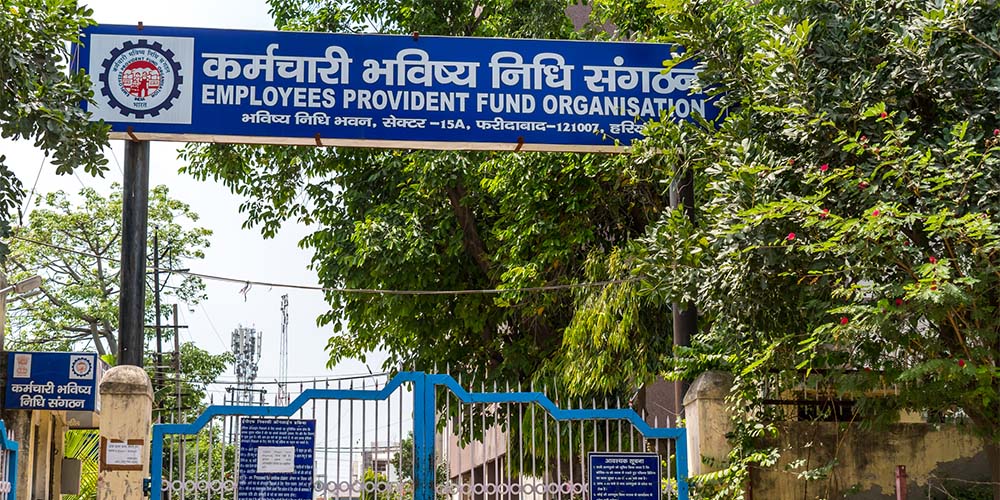
Social security isn’t about saving for retirement; it’s about staying secure through every stage of work.” The Employees’ Provident Fund Organisation (EPFO) has revamped its withdrawal system, consolidating 13 different provisions into just 3 simplified rules. This change focuses on improving financial access for workers while protecting their long-term retirement savings.
| Provision | Before (Old Rules) | Now (New Rules) |
| Partial PF Withdrawals | Allowed only after 5–7 years of continuous service; multiple clauses made it time-consuming and paperwork-heavy. | Can be withdrawn after just 12 months of service for needs like medical emergencies, education, or marriage; auto-settlement with no employer approval required. |
| PF Withdrawal after Job Loss | Full PF withdrawal is allowed only after 2 months of unemployment, often depleting long-term savings. | Members can withdraw 75% of their PF right after losing their job. They can take out the remaining 25% after 12 months if they are still unemployed. This ensures they have access to cash and savings. |
| Pension (EPS) Withdrawal | EPS withdrawal is allowed after 2 months of leaving service. | EPS withdrawal waiting period extended to 36 months under the epfo pension withdrawal new rules, encouraging pension preservation and long-term retirement planning. |
Let’s see how each of these reforms impacts employee access to their savings and what it means for the workforce:
What are the New EPFO Partial Withdrawal Rules?
This reform is designed to provide employees with faster access to their PF corpus during genuine needs, without compromising on compliance. By reducing the eligibility period from several years to just one, EPFO makes sure that even short-tenure or project-based workers can access their savings in emergencies.
The process has been fully digitised, and requests are now settled automatically, eliminating paperwork and employer approvals. This shift particularly benefits contractual and temporary workers, who previously struggled with lengthy approval cycles.
What Happens to PF Savings After Job Loss?
To support income continuity during job transitions, EPFO now allows members to access a significant part of their PF soon after employment ends. The reform provides much-needed liquidity while ensuring a portion of savings remains intact for future security.
The reform provides necessary liquidity and keeps part of the savings safe for future security. This setup is particularly important for workers in fields with frequent job changes or those who work on contract. It offers financial support without pushing for total withdrawals.
What has Changed in the Pension Withdrawal Rules?
EPFO has revised the withdrawal timeline under the Employee Pension Scheme (EPS) to promote retirement stability. Employees who exit before completing 10 years of service must now retain their pension balance for a longer duration before withdrawal.
The epfo pension withdrawal new rules have introduced a major shift in how employees can access their pension corpus. This extension encourages savings discipline and helps more workers qualify for lifelong pension benefits, strengthening India’s social security framework.
How EPFO Reforms Impact India’s Workforce?
These reforms mark a significant shift in how India manages employment-linked social security. The focus is on ensuring that funds are readily available for genuine needs while maintaining a minimum balance for future security. The epfo pension withdrawal new rules also make it easier for short-term and gig workers to stay connected with the formal financial system, building long-term trust and inclusion.
For associates across diverse employment types: permanent (those directly and long-term employed by a company), temporary (those directly hired by the company for a short-term need), or contractual (those hired by a third-party staffing agency, which is their legal employer), the new rules offer both flexibility and a clear structure for managing their financial safety net.
What Do Labour Codes Mean for Employers?
While the new EPFO withdrawal rules simplify access for employees, they also introduce a few operational shifts for employers. With partial withdrawals now auto-settled digitally, companies must ensure that employee records, KYC details, and monthly PF filings are fully accurate and updated to avoid settlement delays or compliance flags. The reduced role of employer approvals removes administrative bottlenecks, but it also increases the need for cleaner data, timely filings, and stronger HRMS–EPFO integration. The longer lock-in period for pension withdrawals also means companies must counsel exiting employees better on pension eligibility and settlement timelines. For staffing-intensive sectors, frequent joiners and leavers may require tighter payroll coordination to avoid mismatches. Overall, while the reforms reduce paperwork and employer intervention, they raise expectations around digital compliance discipline and real-time data accuracy.
A Step Toward Digital and Inclusive Social Security
Take, for instance, an employee who needs emergency funds for a medical procedure. Earlier, accessing even a small portion of PF could take weeks due to documentation and employer sign-offs. Now, with the auto-settlement system through the EPFO’s Unified Member Portal, the same worker can receive funds within days. This not only reflects how data integration and automation improve financial access but also reinforces trust in formal employment over informal borrowing options.
This shows how data integration and automation improve financial access. It also fosters trust in formal employment over informal borrowing options. As employment patterns change and formal coverage grows, these shifts represent a move toward a more data-driven and technology-supported social security system. This system aims to balance short-term liquidity with long-term financial stability.
Get expert support for PF and labour reforms here
Author
Latest Blogs
Retail Staffing and Recruitment Challenges in India
India's retail sector is undergoing a period of rapid transformation. Driven by rising consumer spending, the expansion of organized retail, omnichannel business models, and growing...
Read MoreCombat Employee Turnover with Predictive AI
Employee attrition has become one of the biggest workforce challenges for modern businesses. It impacts productivity, hiring costs, and long-term growth. Traditional retention strategies often...
Read MoreFuture of Work: Upskilling and Reskilling in the AI Era
The acceleration of artificial intelligence is reshaping labor markets at a pace that conventional education and workforce systems struggle to match. This is not merely...
Read MoreHiring Trends 2026: Workforce Solutions for Recruitment Challenges
India’s labour market in 2026 is undergoing a structural shift. While economic expansion, digital transformation, and AI adoption are accelerating hiring demand, employers continue to...
Read MoreTalent Management Strategy 2026: Skills-First Future-Ready Workforces
Talent management strategy is undergoing a fundamental shift as organizations move beyond traditional hiring models toward building agile, skills-driven workforces. Rapid technological change, AI-led disruption,...
Read MoreDifference Between Recruitment and Hiring: Key Insights

The words recruitment and hiring are often used interchangeably. At first glance, they seem to mean the same thing, bringing people into an organisation. But anyone who’s worked in HR, staffing, or business operations knows that these two terms, though closely linked, represent different stages of a much larger process.
Understanding that difference isn’t just a matter of semantics, it’s the key to building a smarter, more sustainable workforce strategy.
-
Recruitment vs. Hiring: The Fundamental Difference
Recruitment is about identifying, reaching out to, and engaging potential talent for a role.
Hiring, on the other hand, is about selection and integration, choosing the right candidate and completing the formal steps to bring them into the organisation.
Think of recruitment as fishing in the right waters and hiring as choosing the right catch and making sure it fits your basket.
Recruitment involves activities such as:
- Crafting job descriptions
- Posting vacancies on job portals and social media
- Searching databases for potential candidates
- Screening resumes and conducting initial assessments
- Employer branding to attract the right talent
Hiring includes:
- Conducting final interviews
- Evaluating shortlisted candidates
- Making offers and negotiating terms
- Background checks and onboarding
So, while recruitment builds the pipeline of possibilities, hiring converts those possibilities into people who join your team.
-
The Recruitment Stage: Building the Right Talent Pipeline
The recruitment process starts much before the first resume arrives. It begins with understanding what the business needs. Understanding the difference between recruitment and hiring helps organisations design better processes and reduce time-to-fill without compromising on quality.
Recruitment is therefore both strategic and relationship-driven. It’s not just about filling seats; it’s about building a network of potential candidates who align with your organization’s values and long-term goals.
Example: A FMCG company looking for sales promoters may not need permanent staff for every region. Through a recruitment partner, they can build a flexible database of field associates who can be deployed during product launches or festive campaigns. This ensures speed, consistency, and brand recall, even before hiring begins.
-
The Hiring Stage: Making the Right Match
Hiring begins once you have a shortlist of potential candidates. This stage is about making informed decisions and ensuring a smooth transition from candidate to employee.
Good hiring is data-driven but human-centred. While assessments and metrics play a role, what matters equally is understanding cultural fit, motivation, and the individual’s ability to grow with the company.
Example: A logistics company may receive 500 applications for delivery executives. Recruitment ends once those profiles are sourced and filtered. Hiring begins when managers conduct interviews, check driving records, verify documents, and finalise offers. The process is operational, but the difference between a smooth hire and a bad one lies in attention to detail; a delayed offer or poor onboarding experience can quickly push a candidate to a competitor.
In today’s competitive job market, the hiring experience is a reflection of your employer brand. From communication and responsiveness to how feedback is delivered, every touchpoint affects how potential employees perceive your organisation.
-
Why the Distinction Matters
a. Strategic Planning: Recruitment is long-term. It builds talent pipelines, nurtures relationships, and aligns with business forecasting. Hiring is immediate. It responds to current vacancies and ensures business continuity.
If a company invests only in hiring without strengthening its recruitment engine, it ends up in a cycle of reactive decisions, always rushing to fill gaps rather than building a sustainable workforce.
b. Employer Branding: Recruitment shapes perception. The way job posts are written, interviews are conducted, and candidates are treated all of this impacts how your organization is viewed in the job market.
Hiring solidifies that perception. Once a person joins, their onboarding experience decides whether they become brand advocates or cautionary tales.
c. Cost and Efficiency: A well-structured recruitment process reduces hiring costs. For instance, maintaining a talent database or collaborating with staffing partners helps fill future roles faster and more affordably than starting from scratch each time.
-
The Modern Reality: Recruitment and Hiring Are Converging
The line between recruitment and hiring has blurred over the past few years, thanks to technology, analytics, and evolving workforce models, making recruitment vs hiring even more nuanced in today’s dynamic work environment.
Digital tools from AI-driven resume screening to predictive analytics now allow recruiters and hiring managers to collaborate in real time.
Platforms like LinkedIn, job boards, and staffing tech solutions create a continuous loop of talent identification, engagement, and onboarding.
Moreover, the rise of flexible staffing and gig employment has changed the definition of “hiring” itself. For many industries, especially logistics, retail, e-commerce, and manufacturing, the focus has shifted from permanent hires to deploying the right talent at the right time.
-
The Human Side of Recruitment and Hiring
Behind every resume lies a person with goals, constraints, and aspirations. Whether you’re recruiting or hiring, the human touch defines your success.
It’s easy to automate processes, but challenging to automate empathy. The best organisations combine the efficiency of systems with the sincerity of human interaction.
Conclusion
Recruitment and hiring are two sides of the same coin – one focused on finding people, the other on bringing them in. Recruitment builds relationships; hiring seals commitments. Together, they form the backbone of every successful workforce strategy.
In an economy where talent is both scarce and mobile, understanding recruitment vs hiring isnt academic; it’s strategic. It’s what separates organisations that constantly chase talent from those that attract it naturally.
Looking to strengthen your recruitment and hiring strategy?
Partner with TeamLease to build a future-ready, compliant, and scalable workforce.
Author
Latest Blogs
Retail Staffing and Recruitment Challenges in India
India's retail sector is undergoing a period of rapid transformation. Driven by rising consumer spending, the expansion of organized retail, omnichannel business models, and growing...
Read MoreCombat Employee Turnover with Predictive AI
Employee attrition has become one of the biggest workforce challenges for modern businesses. It impacts productivity, hiring costs, and long-term growth. Traditional retention strategies often...
Read MoreFuture of Work: Upskilling and Reskilling in the AI Era
The acceleration of artificial intelligence is reshaping labor markets at a pace that conventional education and workforce systems struggle to match. This is not merely...
Read MoreHiring Trends 2026: Workforce Solutions for Recruitment Challenges
India’s labour market in 2026 is undergoing a structural shift. While economic expansion, digital transformation, and AI adoption are accelerating hiring demand, employers continue to...
Read MoreTalent Management Strategy 2026: Skills-First Future-Ready Workforces
Talent management strategy is undergoing a fundamental shift as organizations move beyond traditional hiring models toward building agile, skills-driven workforces. Rapid technological change, AI-led disruption,...
Read MoreHow HR Outsourcing Increases Hiring Efficiency

If there’s one constant in the world of business, it’s change, new projects, new clients, new markets, and with them, the urgent need to scale teams quickly. But ask any HR professional, and they’ll tell you: hiring at scale isn’t easy. Finding the right people, managing timelines, maintaining quality, and keeping costs in check is a complex equation that internal teams often struggle to balance.
That’s where HR outsourcing comes in, not just as a cost-cutting measure, but as a strategic lever to boost hiring efficiency, strengthen processes, and simplify large-scale recruitment. Especially when it comes to bulk hiring, outsourcing can turn an overwhelming task into a streamlined, data-backed, and results-driven process.
The New Reality of Hiring at Scale
Recruitment today is more competitive, multi-channel, and analytics-driven than ever before. Businesses are under constant pressure to ramp up fast, whether to meet festive demand, expand operations, or onboard new projects. Yet internal HR teams often find themselves juggling too many roles: sourcing, screening, onboarding, compliance, and engagement.
Bulk hiring amplifies these challenges. You’re not only filling multiple positions; you’re aligning talent with timelines and budgets while ensuring every new hire contributes to business goals. HR outsourcing bridges this gap, providing the scale, systems, and speed that modern businesses need to hire efficiently.
How HR Outsourcing Drives Hiring Efficiency
HR outsourcing is no longer about delegation; it’s about partnership. It combines technology, domain expertise, and flexible delivery models to ensure that recruitment runs smoothly, even when the volume spikes.
Here’s how it makes hiring more efficient and effective:
- Access to On-Demand Expertise: Outsourcing partners bring recruitment experts who understand diverse industries, roles, and geographies. Instead of stretching internal HR bandwidth, organisations get access to pre-trained recruiters, established processes, and ready talent networks. For bulk hiring, this means faster turnarounds and reduced dependence on ad-hoc hiring agencies.
- Speed and Scale, Without Compromising Quality: When it comes to volume hiring, time is money. HR outsourcing partners leverage technology, from AI-powered sourcing tools to automated assessments, to move candidates through the funnel faster. With access to verified databases and pre-screened profiles, organisations can hire candidates in days, not weeks, without diluting quality standards.
- Data-Driven Recruitment: What gets measured gets improved. Outsourced HR teams track metrics like cost-per-hire, source efficiency, and offer-to-joining ratios, helping businesses make data-backed decisions. This analytical layer enables forecasting and optimisation — critical when planning bulk hiring drives across multiple locations.
- Flexibility for Seasonal or Project-Based Hiring: Every organisation faces hiring peaks during product launches, festive seasons, or new plant setups. HR outsourcing offers the flexibility to scale recruitment up or down as needed. It ensures that hiring remains agile, responsive, and cost-efficient, even when requirements fluctuate dramatically.
- Compliance and Candidate Experience: Bulk recruitment often brings the challenge of documentation, payroll, and onboarding compliance. HR outsourcing ensures these backend processes run smoothly and legally. At the same time, structured communication and faster processing enhance the candidate experience, an underrated but powerful factor in improving employer brand perception.
Turning Bulk Hiring Into a Strategic Advantage
When managed strategically, bulk hiring isn’t just about filling vacancies; it’s about fueling growth. Outsourcing partners can help businesses design long-term workforce strategies, identify sourcing hotspots, build talent pipelines, and even train or upskill candidates before deployment.
This proactive approach not only improves hiring efficiency but also creates a consistent, reliable workforce model, especially vital for industries like manufacturing, retail, logistics, BFSI, and e-commerce, where large-scale hiring is a recurring need.
With the right HR outsourcing partner, businesses can transform bulk hiring from a reactive challenge into a competitive advantage.
The Human Side of HR Outsourcing
Despite all the automation and analytics, the real success of HR outsourcing lies in its human element. The best partners don’t just process resumes; they understand company culture, align with business values, and ensure every hire contributes to long-term success.
In other words, outsourcing works best when it feels like an extension of your own HR team, not a replacement. It’s a collaboration that combines efficiency with empathy, process with personalisation.
In Summary
HR outsourcing is more than an operational fix; it’s a strategic growth driver. It helps organisations achieve hiring efficiency through speed, data, and scalability while simplifying the complexities of bulk hiring.
At TeamLease, we have enabled leading enterprises across India to manage end-to-end hiring, from bulk recruitment and staffing to payroll, compliance, and training. With a presence in pan-India locations and a base of over 3 lakh associates, we bring the scale and expertise businesses need to stay agile.
Our HR outsourcing solutions are built to align with your goals, ensuring you get the right people, at the right time, with measurable impact.
Looking to make your hiring faster, smarter, and more efficient? Let’s build your workforce advantage together.
Author
Latest Blogs
Retail Staffing and Recruitment Challenges in India
India's retail sector is undergoing a period of rapid transformation. Driven by rising consumer spending, the expansion of organized retail, omnichannel business models, and growing...
Read MoreCombat Employee Turnover with Predictive AI
Employee attrition has become one of the biggest workforce challenges for modern businesses. It impacts productivity, hiring costs, and long-term growth. Traditional retention strategies often...
Read MoreFuture of Work: Upskilling and Reskilling in the AI Era
The acceleration of artificial intelligence is reshaping labor markets at a pace that conventional education and workforce systems struggle to match. This is not merely...
Read MoreHiring Trends 2026: Workforce Solutions for Recruitment Challenges
India’s labour market in 2026 is undergoing a structural shift. While economic expansion, digital transformation, and AI adoption are accelerating hiring demand, employers continue to...
Read MoreTalent Management Strategy 2026: Skills-First Future-Ready Workforces
Talent management strategy is undergoing a fundamental shift as organizations move beyond traditional hiring models toward building agile, skills-driven workforces. Rapid technological change, AI-led disruption,...
Read More5 Shifts Reflecting the Changing Consumer Movement in India

The Indian FMCG sector is undergoing a profound transformation. Valued at over $250 billion in 2025, it is projected to reach $1.1 trillion by 2033, driven by evolving consumer movement in India, technology adoption, and changing lifestyles. From health-conscious choices to digital-first purchasing, these shifts are not just trends; they are redefining the way FMCG companies operate and engage with consumers. These rapid shifts aren’t just shaping consumer behaviour; they’re creating new workforce challenges, especially related to the workforce. Organisations must rethink hiring strategies, workforce flexibility, and digital tools to meet evolving consumer demands efficiently through effective workforce management.
- Why Is Direct-to-Consumer (D2C) Disrupting Traditional Channels?
The D2C model is reshaping retail, with India’s D2C e-commerce market valued at $87.5 billion in 2025, expected to cross $320 billion by 2033. Agile brands are reaching consumers directly, building personalised experiences, and responding to feedback faster than traditional players. This shift reflects the changing consumer movement in India, where buyers now expect customised, transparent, and efficient interactions with brands. The D2C boom creates demand for roles in e-commerce operations, customer experience, and delivery partners. Organisations must plan for hiring and upskilling to manage employees and delivery partners effectively, ensuring seamless direct-to-consumer operations. - What Do Conscious Consumers Really Want?
Modern consumers increasingly demand products that are natural, organic, and sustainably sourced. FMCG brands are responding with transparent labelling, eco-friendly packaging, and products that reflect social and environmental responsibility. Integrating consumer responsibilities into product strategies not only meets demand but also strengthens brand credibility. The future consumer increasingly makes choices based on ethics and sustainability, turning conscious consumption into a market driver.
- What’s Driving the Health and Wellness Revolution?
Indian consumers are increasingly prioritising their well-being, reflecting a growing sense of consumer responsibility. The nutritional supplements market in India, valued at around $21 billion in 2025, is expected to reach $57 billion by 2033, with a CAGR of 11.14%. FMCG companies are responding by fortifying products, launching plant-based and functional foods, and expanding health-focused offerings. From protein powders to functional snacks, the future consumer is no longer confined to gyms or health stores – they are integrating wellness into everyday life. Brands that align with these choices are likely to build stronger loyalty and long-term engagement. - Why Is a Flexible Workforce Key to FMCG Agility?
The pace of change in the FMCG sector has made traditional employment models insufficient. Companies are embracing a flexible workforce, leveraging gig talent for last-mile delivery, warehousing, and sales. This ensures that operations can scale up or down in response to seasonal or hyperlocal demand. An efficient distributor and consumer management system, combined with workforce flexibility, allows FMCG companies to respond to the changing consumer movement in India without compromising speed or service quality. - How Are Companies Adapting to This New Reality?
These shifts underscore the importance of agile hiring, digital workforce management, upskilling, and flexible deployment strategies. Organisations that align their talent strategy with the future consumer mindset will lead in the rapidly evolving, increasingly conscious, and driven-by-choice era. FMCG companies are not merely observing these trends; they are actively adapting to meet the changing needs of the future consumer. Investments in digital infrastructure, D2C channels, health-oriented product lines, and a hybrid workforce are helping brands navigate this dynamic market.The consumer shifts in India are more than a trend; it’s a blueprint for how companies will engage, innovate, and grow in the next decade. Those who embrace these shifts will lead the way in a sector that is rapidly evolving, increasingly conscious, and powered by choice.
Author
Latest Blogs
Retail Staffing and Recruitment Challenges in India
India's retail sector is undergoing a period of rapid transformation. Driven by rising consumer spending, the expansion of organized retail, omnichannel business models, and growing...
Read MoreCombat Employee Turnover with Predictive AI
Employee attrition has become one of the biggest workforce challenges for modern businesses. It impacts productivity, hiring costs, and long-term growth. Traditional retention strategies often...
Read MoreFuture of Work: Upskilling and Reskilling in the AI Era
The acceleration of artificial intelligence is reshaping labor markets at a pace that conventional education and workforce systems struggle to match. This is not merely...
Read MoreHiring Trends 2026: Workforce Solutions for Recruitment Challenges
India’s labour market in 2026 is undergoing a structural shift. While economic expansion, digital transformation, and AI adoption are accelerating hiring demand, employers continue to...
Read MoreTalent Management Strategy 2026: Skills-First Future-Ready Workforces
Talent management strategy is undergoing a fundamental shift as organizations move beyond traditional hiring models toward building agile, skills-driven workforces. Rapid technological change, AI-led disruption,...
Read MoreHow a Manpower Supply Agency Simplifies HR Recruitment Process

Hiring the right people, at the right time, and for the right cost is a perpetual challenge for organisations. Today’s talent market is faster, more specialised, and more unpredictable than ever, and that’s where a manpower supply agency can turn complexity into clarity. By acting as an extension of an organisation’s talent function, a manpower supply agency streamlines the entire HR recruitment process, improves speed and quality of hire, reduces compliance risk, and helps companies scale workforce strategies with confidence.
Why the HR recruitment process needs simplifying
Three big market realities make simplification necessary:
- Shifting hiring models – Contractual and flexible hiring are on the rise in India as employers balance costs, flexibility, and demand spikes. Industry reports show notable growth in contractual hiring and temporary staffing over 2024-25, with several sectors (manufacturing, e-commerce, FMCG and retail) expanding temporary headcount.
- Long, friction-filled hiring cycles – Globally, the time-to-hire varies widely but remains a major cost driver; many sources report averages around 30-44 days depending on role and region, and organisations that shorten this window gain a clear competitive edge. Digital tools and specialised partners are helping compress these timelines.
- Skills mismatch and engagement headwinds – Large parts of the workforce remain in lower-competency roles while demand for specialised skills rises, making sourcing and upskilling imperative. Meanwhile, recent research on workforce engagement trends reveals pressure on retention and productivity, an area where smoother recruiting and onboarding processes are crucial.
These factors put strain on internal HR teams, elongate the HR recruitment process, and raise hiring costs. A specialised manpower supply agency is designed to relieve that strain.
How a manpower supply agency simplifies the HR recruitment process
- Ready-to-deploy talent pools (sourcing, faster)
Agencies maintain databases of screened candidates across roles and geographies, from entry-level manufacturing staff to specialised tech contractors. This pre-built supply means sourcing time drops sharply, enabling organisations to plug skill gaps quickly and reduce time-to-hire. For companies facing demand spikes (seasonal or project-based), this immediacy is invaluable. - Quality screening and role-fit matching
Beyond resumes, agencies conduct role-aligned assessments, verification, and initial cultural-fit screenings. By delivering a curated short-list, they remove the low-value initial filtering work from HR’s plate and improve conversion rates in interviews, making the HR recruitment process leaner and more outcome-focused. - Shorter hiring cycles and reduced loss of candidates
Candidates lose interest if hiring processes drag. Agencies accelerate scheduling, initial tests, offer negotiation and onboarding. Shorter cycles mean top talent stays engaged and acceptances rise, a measurable win for time-to-hire metrics that HR teams track closely. - Compliance, payroll & statutory administration
A core advantage of a manpower supply agency is handling statutory compliance, payroll, and contract administration for contingent and temporary staff. This shifts complex regulatory work away from HR operations and reduces legal and administrative risk, particularly in multi-state operations. - Flexible workforce design & cost control
Agencies enable organisations to adopt blended workforce models, permanent + contingent, without the operational burden. That flexibility reduces fixed-cost hiring mistakes and allows HR leaders to align talent capacity to demand forecasts and project cycles. - Upskilling, training & redeployment support
Many agencies now offer training and employability programs to improve candidate readiness for client roles. This increases first-day productivity and reduces the time spent by HR on remedial training, directly improving the outcomes of the HR recruitment process. - Data, insights & continuous improvement
Leading manpower supply agencies provide hiring analytics, including time-to-fill, retention rates of agency-placed hires, cost-per-hire comparisons, and skill-gap maps. These insights help HR teams optimise role profiles, sourcing channels, and compensation strategies, turning recruitment from a tactical process into a strategic capability.
The business impact: faster, cheaper, better hires
When organisations deploy a manpower supply agency as part of their recruitment mix, they typically see:
- Faster fills for urgent roles and seasonal demand.
- Lower the operational load on in-house HR teams, enabling them to focus on engagement and retention.
- Improved compliance outcomes and reduced payroll burden.
- Better cost control through flexible headcount strategies.
Recent industry figures document measurable increases in temporary staffing and contractual hiring across India in 2024-25, underscoring how companies are adopting this model to stay agile.
Technology + agency partnership: the multiplier effect
Modern agencies combine large talent networks with technology, AI screening, scheduling automation, and digital assessments, leading to measurable recruitment efficiency gains. Industry analyses note that recruiters using AI-assisted messaging and digital tools improve quality-of-hire and speed. When your internal HR team partners with a tech-enabled manpower supply agency, the HR recruitment process becomes both faster and smarter.
How TeamLease can help: practical value for HR leaders
TeamLease brings a full-stack staffing and workforce solutions capability that maps directly to the challenges above. With a pan-India presence, a large associate base, and specialised offerings (temporary staffing, specialised recruitment, training & employability programs), TeamLease helps HR teams:
- Cut time-to-hire through ready talent pools and specialist sourcing
- Lower compliance burden by owning statutory payroll and contract administration across states.
- Improve quality of hire via role-specific screening, assessments, and upskilling partnerships.
- Deliver workforce flexibility so HR can dynamically scale project teams, seasonal staff, or specialised cohorts without large fixed costs.
For HR leaders seeking to simplify the HR recruitment process while enhancing outcomes, partnering with an experienced manpower supply agency, such as TeamLease, enables a shift from reactive hiring to a forward-looking, measurable capability.
Check out this case study to understand more!
Author
Latest Blogs
Retail Staffing and Recruitment Challenges in India
India's retail sector is undergoing a period of rapid transformation. Driven by rising consumer spending, the expansion of organized retail, omnichannel business models, and growing...
Read MoreCombat Employee Turnover with Predictive AI
Employee attrition has become one of the biggest workforce challenges for modern businesses. It impacts productivity, hiring costs, and long-term growth. Traditional retention strategies often...
Read MoreFuture of Work: Upskilling and Reskilling in the AI Era
The acceleration of artificial intelligence is reshaping labor markets at a pace that conventional education and workforce systems struggle to match. This is not merely...
Read MoreHiring Trends 2026: Workforce Solutions for Recruitment Challenges
India’s labour market in 2026 is undergoing a structural shift. While economic expansion, digital transformation, and AI adoption are accelerating hiring demand, employers continue to...
Read MoreTalent Management Strategy 2026: Skills-First Future-Ready Workforces
Talent management strategy is undergoing a fundamental shift as organizations move beyond traditional hiring models toward building agile, skills-driven workforces. Rapid technological change, AI-led disruption,...
Read MoreHow Staffing and Recruiting Firms Drive Business Growth Graph

India today is not just growing – it’s racing ahead. With the economy on track to become a $5 trillion powerhouse, businesses are standing at a once-in-a-generation inflection point. Blink, and the opportunity may pass. Ambition alone won’t get companies there, as venture capitalist John Doerr put it, “Ideas are easy. Execution is everything.
That execution depends on people. From identifying the right candidates through talent hunt initiatives to ensuring smooth salary management via payroll companies, every operational detail contributes to growth. This is where staffing and recruiting partners come in, acting as enablers in workforce scaling, compliance-ready payroll, and digital workforce solutions. With reforms and initiatives such as GST 2.0, CRR changes, revamped income tax brackets, PLI, Startup India, and Digital India, the message is clear: this is the time to scale smarter and faster.
But growth, while exciting, comes with its own set of challenges. Scaling a company isn’t just about expanding operations; it’s about scaling without cracks. That means building the right teams with expertise of staffing and recruiting partners, through focused talent hunt efforts, managing payroll seamlessly with trusted payroll companies, going digital, and staying compliant in an environment where regulations evolve as quickly as the opportunities.
The Business Growth Imperative in India
India’s rise is driven by its young population, expanding digital access, and steady government policies that promote business growth. Key long-term initiatives include:
- GST 2.0 streamlines indirect taxation and increases consumption efficiency.
- CRR changes infuse liquidity into the financial system to support growth.
- Revamped income tax brackets, enhancing disposable income and driving higher consumer spending.
- PLI schemes that enhance domestic manufacturing capabilities
- Startup India and Stand-Up India schemes are fostering entrepreneurship
- Ease of Doing Business reforms that simplify compliance and tax processes
- Digital India drive is accelerating financial and digital inclusion across the country
These aren’t short-term sops but structural policies shaping a future-ready business ecosystem. Companies today have the wind at their back – what matters is how they z channel it.
The Talent Equation: Why Staffing and Recruiting Matter
To scale, businesses need people—skilled, reliable, and aligned with growth goals. As Zig Ziglar said, “You don’t build a business, you build people, and people build the business.” Recruitment partners provide:
- Speed: Quick access to a wide talent pool.
- Expertise: Screening and onboarding the right candidates.
- Scalability: Ability to ramp up or down based on project or market demand.
Instead of spreading internal teams thin, recruitment partners help companies stay focused on business while ensuring the right talent is always in place.
Payroll: The Backbone of Employee Trust
Employees are the lifeline of growth. And nothing builds or breaks their trust faster than payroll. Delays, errors, or compliance misses can directly impact morale and retention. Workforce outsourcing partners bring in:
- Accuracy & Timeliness in salary disbursement.
- Automation & Transparency in processes.
- Compliance-Ready Payroll is aligned with PF, ESIC, TDS, and other statutory norms.
When employees are paid correctly and on time, they stay engaged, allowing companies to focus on strategy rather than firefighting. As payroll conversations inevitably lead to questions about talent costs, industry benchmarks, and compensation trends, our latest Jobs & Salaries Primer provides a detailed view of how pay structures are evolving across various sectors.
Digitalisation: The Catalyst for Scalable Workforce Management
As companies expand, digitalisation becomes the real differentiator in managing people and processes at scale. Modern recruitment and Workforce outsourcing partners are no longer just service providers- they are tech-enabled enablers. With integrated digital stacks, they deliver:
- e-KYC and e-Onboarding for faster, paperless onboarding of associates.
- Self-service employee portals give associates instant access to payslips, attendance, and compliance documents.
- Digital access to HR & payroll systems, ensuring transparency and reducing admin burden.
- Automated reporting and analytics to help leadership make smarter workforce decisions.
By embracing digitalisation, businesses not only enhance employee experience but also reduce errors, improve compliance accuracy, and achieve scalability without proportionally increasing HR overhead.
Compliance: Growth Without Headaches
India’s regulatory framework is vast, with labour codes, tax laws, and state-specific rules constantly evolving. A compliance miss can result in penalties, litigation, and reputational risk. Having a compliance partner ensures:
- 100% Statutory Adherence across regions and roles.
- Proactive Monitoring of changes in labour and employment laws.
- Reduced Business Risk so leadership can focus on scaling, not paperwork.
Many workforce outsourcing companies also integrate compliance monitoring, reducing risks while keeping employee trust intact. In a growth environment, compliance is not just about avoiding penalties; it’s about ensuring the foundation of your business is strong and future-ready.
Scaling the Right Way
India is offering businesses the right environment to dream big and scale fast. But the difference between a company that grows sustainably and one that struggles often lies in its ability to manage talent, payroll, digitalisation, and compliance with precision. New markets demand new skills, and a targeted talent hunt ensures companies don’t miss out on emerging workforce opportunities. Sustainable expansion requires more than ambition; it needs precision in staffing and recruiting to align workforce planning with business goals.
By partnering with experts in these areas, businesses can focus on innovation, customer acquisition, and expansion – leaving the operational complexities to those who specialise in them.
Final Thought
The growth runway in India is long and promising. Government policies are creating the platform; businesses have the vision and ambition. The missing piece? A reliable partner for recruitment, payroll, digitalisation, and compliance.
Because scaling isn’t just about growth, it’s about scaling smart.
Ready to scale smart with the right workforce solutions? Contact us to explore services tailored to your business needs.
Author
Latest Blogs
Retail Staffing and Recruitment Challenges in India
India's retail sector is undergoing a period of rapid transformation. Driven by rising consumer spending, the expansion of organized retail, omnichannel business models, and growing...
Read MoreCombat Employee Turnover with Predictive AI
Employee attrition has become one of the biggest workforce challenges for modern businesses. It impacts productivity, hiring costs, and long-term growth. Traditional retention strategies often...
Read MoreFuture of Work: Upskilling and Reskilling in the AI Era
The acceleration of artificial intelligence is reshaping labor markets at a pace that conventional education and workforce systems struggle to match. This is not merely...
Read MoreHiring Trends 2026: Workforce Solutions for Recruitment Challenges
India’s labour market in 2026 is undergoing a structural shift. While economic expansion, digital transformation, and AI adoption are accelerating hiring demand, employers continue to...
Read MoreTalent Management Strategy 2026: Skills-First Future-Ready Workforces
Talent management strategy is undergoing a fundamental shift as organizations move beyond traditional hiring models toward building agile, skills-driven workforces. Rapid technological change, AI-led disruption,...
Read MoreIndia’s Economic Reset 2025: GST 2.0, Tax Reforms & Workforce Agility

An Economic Reset Demanding Workforce Agility
India’s economic architecture is going through a major reset. The government’s rollout of GST 2.0 marks a clear simplification of indirect taxes. The goal is to reduce complexities and put more cash into consumers’ hands.
Reports show slowing household demand has been a concern recently. This matters because India is a consumption-driven economy, where household spending makes up about 60% of GDP, while exports contribute around 20%. So, our growth is driven by consumer spending. GST 2.0 eases compliance and directly improves cash flow for consumers, setting the stage for revived demand.
Alongside GST reforms, income tax changes are raising disposable incomes. These reforms are expected to put roughly ₹2 lakh crore more annually into the pockets of middle- and upper-middle-class households.
On the monetary side, RBI’s rate cuts are reducing borrowing costs, easing capital conditions across industries. Together, these policies inject significant disposable cash and unlock a fresh wave of consumption. This creates a broad economic momentum that businesses cannot ignore.
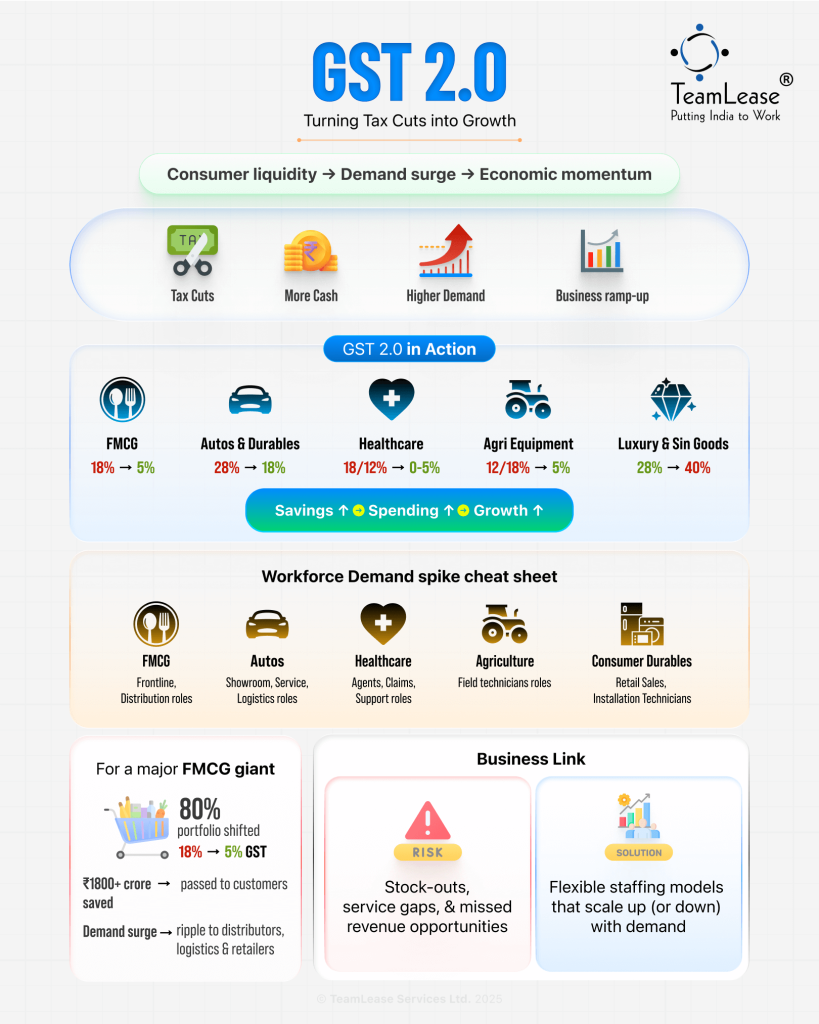
Yet, this reset isn’t smooth sailing. Companies are navigating mid-year repricing, supply chain shifts, and budget reshuffles. These challenges will test how agile their business functions are, how quickly they can restructure their sales, operations, marketing as well as how flexible their workforce strategies really are.
For CEOs, CFOs, HR heads, and Sales and Operations leaders alike, the question now isn’t just how to grow – it’s how to stay agile amid change.
In this blog, we are answering the following questions:
- What is GST 2.0 and how does it simplify India’s tax system?
- How do GST 2.0 reforms impact consumer spending and the economy?
- What role do income tax reforms and RBI rate cuts play alongside GST 2.0?
- How do GST 2.0 reforms affect different industries like FMCG, manufacturing, and real estate?
- What are the operational and workforce challenges due to GST 2.0 and how can contract staffing help?
- Why is workforce agility critical in the GST 2.0 economic reset?
- How should businesses restructure workforce strategies in response to India’s tax reforms?
- What benefits does contract staffing provide for handling demand volatility post GST reforms?
We intend to break down these reforms and their impact on key industries, showing why contract staffing is no longer just a short-term fix but a strategic necessity.
The Reform Framework: What GST 2.0 and Complementary Policies Bring
GST 2.0 reshapes India’s tax slabs from a multi-tiered structure (5%, 12%, 18%, 28%) to primarily two (5% essentials, 18% general) and introduces a 40% slab on luxury goods. This not only streamlines compliance but significantly eases the working capital burden from tax arbitrage and refund complexities.
Simultaneously, income tax reforms enhance consumer purchasing power, cushioning inflationary pressures and accelerating consumption cycles. RBI’s measured rate cuts lower borrowing costs, particularly impacting capital-intensive sectors such as real estate and infrastructure by unlocking stalled investments.
The synergy of these policies amplifies growth stimuli but also introduces demand volatility and operational flux, weaving a complex tapestry against which workforce strategies must be aligned.
Industry-Specific Workforce Realignment: Opportunities and Challenges
FMCG & Retail: Adapting Packaging and Logistics for Consumer Demand
The reform has huge FMCG GST impact. It reduces input costs for essentials, creating price competitiveness and heightened consumer demand especially in semi-urban and rural markets. Behind this consumer-facing clarity lies operational complexity: new packaging, packaging grammage recalibration, pricing, warehouse (be it the pallet and carton size!) and truck route redesign, and accelerated promotional plans.
Permanent workforce structures, characterized by fixed costs and limited redeployment flexibility, can become a bottleneck. Contingent staffing here becomes crucial, delivering rapid deployment of warehouse operatives, logistic handlers, and retail field staff whose engagement can flex in lockstep with market shifts. Download and read our detailed report on FMCG Contract staffing in India.
Automotive and Manufacturing: Navigating Mid-Cycle Repricing with Workforce Agility
GST rate cuts on automobiles, two-wheelers, and key manufacturing inputs have led to meaningful price reductions (example announcement by Tata Motors). These changes have sparked renewed demand across automotive, and manufacturing sectors. For example, GST cuts from 28% to 18% on automotive components and machinery have trimmed prices by up to 8–10%, giving a boost to sales. RBI’s rate cuts have further eased financing costs, fueling growth.
Benefits of GST on manufacturing will be multifold in India’s GDP. The manufacturing sector remains a key pillar of the economy, contributing nearly 17% to GDP. In FY 2024-25, manufacturing output grew by 4.26%, with the Index of Industrial Production expanding 5.4% year-on-year in July 2025 – the strongest pace in recent months. Key segments such as basic metals, electrical equipment, and machinery recorded robust growth. However, mid-year price resets challenge production and supply chains. Automotive and manufacturing firms are revising Annual Operating Plans to align with fluctuating input costs and evolving demand.
Contract staffing plays a crucial role here. It enables OEMs and manufacturers to flexibly scale assembly-line workers, quality inspectors, and supplier-side labor. This approach reduces fixed commitments and aligns workforce costs with real-time production needs. By mitigating risk and enhancing responsiveness, contract staffing helps businesses navigate ongoing volatility without sacrificing efficiency or quality. Check out our report on contract staffing in Manufacturing.
Real Estate & Infrastructure: Unlocking Stalled Projects through Agile Manpower
The recent GST 2.0 reforms have brought welcome relief to the real estate and infrastructure sectors. By reducing GST rates on critical construction materials like cement from 28% to 18%, and bricks and tiles from 18% to as low as 5%. According to a report by Hindustan Times overall construction costs are expected to fall by 3–5%. This reduction directly improves project viability and affordability, especially in affordable and mid-segment housing. Industry experts estimate that these tax cuts could lower home prices by 1–1.5%, making ownership more attainable and helping revive demand ahead of seasonal buying cycles. Additionally, the sector has seen supportive monetary policy through RBI’s rate cuts which have eased borrowing costs, unlocking stalled projects and enabling fresh capital inflows.
However, while these reforms boost optimism, project execution remains complex and uncertain. Developers are navigating renegotiated supplier contracts as input costs adjust and financing schedules shift under the new economic conditions. The simplification of GST into two main slabs (5% and 18%) has increased transparency but demands careful compliance and robust invoicing to ensure input tax credit is maximized. These factors contribute to operational lag and require dynamic responses on the ground, from procurement to site management.
In this context, contract staffing emerges as a crucial enabler of agility for real estate and infrastructure firms. Deploying contract site engineers, skilled labor, and project managers allows developers to scale manpower precisely according to project phases – avoiding the fixed costs and risks of permanent headcount. This flexibility is essential to absorb fluctuations in demand and cash flow while maintaining construction quality and timelines. Contract staffing thus provides the operational resilience developers need to capitalise on GST 2.0 benefits and navigate an evolving market with confidence.
Other Industries: Broad-Based Gains and Digital Transformation
Beyond the headline sectors, GST 2.0 reforms ripple across diverse industries reshaping competitiveness and operational dynamics. The streamlined two-rate system and faster digital compliance reduce tax disputes and unlock working capital for MSMEs, a backbone employing 111 million Indians and contributing nearly 30% of GDP. Lower GST on inputs like textiles, pharmaceuticals, and electronics bolsters manufacturing and exports. For example, healthcare sees GST cuts on cancer drugs and medical equipment, improving affordability and capacity building. Logistics costs fall due to cheaper fuel and vehicle taxes, accelerating movement and delivery.
E-commerce benefits from real-time invoice matching and faster refunds, driving efficiency gains and expanding market reach. As GST digitization advances, companies must upgrade ERP systems and retool workforce skills, creating demand for IT and finance professionals adept in compliance technologies.
This broad-based impact underscores why all business leaders must urgently integrate agile workforce strategies to capture growth, manage volatility, and sustain resilience across sectors.
A case in point
TeamLease supported a leading global electronics manufacturer with complex compliance and payroll challenges across multiple plants in India. Key results included:
- 100% payroll compliance and error-free processing
- Rapid, large-scale candidate sourcing for diverse roles
- 26% CAGR in associate growth over 8 years
- Significant boost in operational efficiency and manpower scalability
This exemplifies how contract staffing solves diverse industry challenges, enabling businesses to stay agile and compliant amid GST reforms and market shifts.
Why Contract Staffing is a Strategic Advantage – Beyond Cost Management
Contract staffing in this context is a lever of strategic agility, enabling companies to:
- Absorb volatility from mid-year pricing and supply chain realignments.
- Adjust workforce scale dynamically, syncing labour costs with revenue flow.
- Access specialized transitional skills, such as AI-driven demand forecasting and project management.
- Mitigate risk exposure through flexible, scalable contracts with escalation mechanisms.
- Pivot to flexi staffing deployment rapidly in response to evolving Annual Operating Plans or regulatory shifts.
This is a fundamental evolution from viewing contract staffing as stopgap to embracing it as a key enabler of operational resilience and strategic flexibility.
Layering Income Tax Reforms and RBI Rate Cuts: The Demand Multiplier
The combined effect of GST 2.0 rationalization, income tax relief, and RBI rate cuts acts as a powerful multiplier for India’s consumer and industrial growth. GST 2.0’s simplified two-slab system (5% and 18% – of course 40% of specific goods) reduces taxes on essentials and manufacturing inputs, lowering costs and boosting affordability. The 2025 Union Budget increased the income tax exemption limit to ₹12 lakh, putting an estimated ₹2 lakh crore back in the hands of middle- and upper-middle-income groups annually. This creates strong consumption demand and spending power.
Meanwhile, RBI’s three repo rate cuts have brought borrowing costs down, for example reducing housing loan EMIs by ₹47,000 annually on a ₹1 crore loan. This eases access to credit across sectors, accelerating investments and job growth.
Together, these fiscal and monetary reforms free up liquidity, driving faster consumption cycles and industrial expansion. Businesses with flexible workforce models, particularly using contract staffing, can align labor costs dynamically to capture the full advantage of this reform-driven demand surge.
Conclusion: Agility is the Currency of Competitiveness
India’s GST 2.0 and accompanying tax reforms mark a structural inflection point. CEOs, Business leaders and in specific HR leaders must urgently revisit their budgets and projections in light of GST 2.0. Companies that reimagine their short term AOP and workforce strategy to embed elasticity and nimbleness through contract staffing will transform disruption into a competitive advantage.
For leaders deliberating their workforce roadmap due to GST reform, the message is clear: agility is not optional; it is paramount for growth, resilience, and sustainable value creation.
Reach out today to empower your business with Resilience, Agility, and Excellence.
Author
Latest Blogs
Retail Staffing and Recruitment Challenges in India
India's retail sector is undergoing a period of rapid transformation. Driven by rising consumer spending, the expansion of organized retail, omnichannel business models, and growing...
Read MoreCombat Employee Turnover with Predictive AI
Employee attrition has become one of the biggest workforce challenges for modern businesses. It impacts productivity, hiring costs, and long-term growth. Traditional retention strategies often...
Read MoreFuture of Work: Upskilling and Reskilling in the AI Era
The acceleration of artificial intelligence is reshaping labor markets at a pace that conventional education and workforce systems struggle to match. This is not merely...
Read MoreHiring Trends 2026: Workforce Solutions for Recruitment Challenges
India’s labour market in 2026 is undergoing a structural shift. While economic expansion, digital transformation, and AI adoption are accelerating hiring demand, employers continue to...
Read MoreTalent Management Strategy 2026: Skills-First Future-Ready Workforces
Talent management strategy is undergoing a fundamental shift as organizations move beyond traditional hiring models toward building agile, skills-driven workforces. Rapid technological change, AI-led disruption,...
Read MoreEnd-to-End Recruitment Process: How HRO is Changing the Game

Walk into any thriving business, whether a fast-scaling startup or a Fortune 500 company, and you’ll notice one common thread: success depends on people. Hiring the right talent at the right time is no longer just an HR function; it’s a business-critical process that impacts productivity, culture, and long-term growth.
That’s where the end-to-end recruitment process comes in. More than just filling vacancies, it’s a structured, strategic approach to identifying, attracting, hiring, and retaining the best-fit candidates. Increasingly, businesses are also exploring Human Resource Outsourcing (HRO) to make this process more efficient, scalable, and cost-effective.
What is the End-to-End Recruitment Process?
The end-to-end recruitment process covers every stage of hiring, from planning to onboarding. Think of it as a journey that starts with identifying a business need and ends when a new hire is fully integrated into the organisation.
Here are the key stages:
- Workforce Planning: Before you even post a job, you need clarity on why you’re hiring. Is it to replace someone? Support a new business line? Scale during peak demand? Workforce planning ensures that hiring aligns with business goals rather than being a knee-jerk reaction.
Example: A retail company anticipates festive season demand and plans for additional customer service agents months in advance instead of scrambling at the last minute. - Job Description Creation: A well-written JD is more than a checklist of tasks; it’s a sales pitch for the role and the company. Today’s candidates look for culture, growth opportunities, and flexibility as much as salary.
Best practices:- Keep it clear and concise
- Highlight responsibilities, skills, and expectations
- Showcase perks, values, and career growth opportunities
- Talent Sourcing: Gone are the days when posting on a job board was enough. Modern sourcing combines multiple strategies:
- Employee referrals
- Job portals
- Social media campaigns
- Campus hiring
- Manpower agencies and external recruiters
- Screening and Shortlisting: This stage separates “maybes” from “matches.” While AI-powered tools can filter resumes for keywords and qualifications, the human touch is crucial to assess cultural fit, adaptability, and attitude.
Typical steps include:
- Resume screening
- Skills assessments or tests
- Phone/video pre-screening
- Use behavioural questions to test real-world problem solving
- Involve team members for culture alignment
- Give candidates an honest view of challenges
- Resume screening
- Interviewing: Interviews are a two-way street. Employers evaluate candidates, but candidates are also assessing the company. That’s why structured, transparent, and conversational interviews lead to better outcomes.
Best practices: - Selection and Offer Management: Once you find the right candidate, clarity is critical. Offer letters should outline compensation, benefits, and terms clearly. Quick turnaround helps reduce drop-offs, as top talent often juggles multiple offers.
- Onboarding: This is where many companies falter. A strong onboarding program boosts retention, engagement, and productivity. Beyond handing out laptops and ID cards, onboarding should:
- Introduce company culture and values
- Assign buddies/mentors
- Provide training and role clarity
- Establish feedback channels
- Introduce company culture and values
Why End-to-End Recruitment Matters
- Consistency: Standardised processes reduce bias and improve fairness.
- Efficiency: Streamlined hiring saves time and resources.
- Employer Branding: A good candidate experience builds reputation, even among those who aren’t hired.
- Retention: Strong onboarding and engagement reduce early attrition.
Where Does HRO Fit Into Recruitment?
Now, let’s bring in Human Resource Outsourcing (HRO). At its core, HRO means delegating some or all HR functions, including recruitment, to an external provider.
Why does this matter? Because not all companies have the bandwidth, expertise, or technology to manage the entire recruitment lifecycle in-house.
Benefits of HRO in Recruitment:
- Scalability: Need 500 seasonal workers for festive demand? HRO partners can mobilise quickly.
- Expertise: Agencies bring industry-specific knowledge and wider talent pools.
- Cost Savings: Outsourcing reduces infrastructure costs (job boards, ATS tools, compliance handling).
- Faster Hiring: External partners streamline sourcing and shortlisting, reducing time-to-fill.
- Compliance & Background Verification: Ensures legal and regulatory compliance, reducing risk.
Example: A fast-growing e-commerce company partners with an HRO provider to manage bulk hiring during festivals, allowing internal HR to focus on strategy and retention.
In-House vs Outsourced Recruitment
| Aspect | In-House Recruitment | HRO (Outsourced Recruitment) |
| Control | Complete control but limited scalability | Shared control, scalable quickly |
| Speed | Can be slow due to resource constraints | Faster with dedicated teams |
| Cost | Fixed costs (salaries, tools, portals) | Variable costs, pay-per-need |
| Expertise | Depends on the internal team’s knowledge | Access to specialised expertise |
| Flexibility | Hard to scale up/down quickly | Easy to scale as per business |
Conclusion
The end-to-end recruitment process is no longer just about finding people; it’s about building the right workforce to achieve business goals. From workforce planning to onboarding, every step must be intentional and candidate-friendly.
At the same time, HRO (Human Resource Outsourcing) is helping companies simplify and scale recruitment, offering cost efficiency, expertise, and agility. Whether you’re a startup scaling fast or an enterprise with complex hiring needs, a thoughtful combination of in-house HR and outsourced solutions can give you the best of both worlds.
In today’s competitive landscape, the companies that win the talent game will be those who see recruitment not as an operational task, but as a strategic advantage.
Author
Latest Blogs
Retail Staffing and Recruitment Challenges in India
India's retail sector is undergoing a period of rapid transformation. Driven by rising consumer spending, the expansion of organized retail, omnichannel business models, and growing...
Read MoreCombat Employee Turnover with Predictive AI
Employee attrition has become one of the biggest workforce challenges for modern businesses. It impacts productivity, hiring costs, and long-term growth. Traditional retention strategies often...
Read MoreFuture of Work: Upskilling and Reskilling in the AI Era
The acceleration of artificial intelligence is reshaping labor markets at a pace that conventional education and workforce systems struggle to match. This is not merely...
Read MoreHiring Trends 2026: Workforce Solutions for Recruitment Challenges
India’s labour market in 2026 is undergoing a structural shift. While economic expansion, digital transformation, and AI adoption are accelerating hiring demand, employers continue to...
Read MoreTalent Management Strategy 2026: Skills-First Future-Ready Workforces
Talent management strategy is undergoing a fundamental shift as organizations move beyond traditional hiring models toward building agile, skills-driven workforces. Rapid technological change, AI-led disruption,...
Read MoreDriving Employee Productivity in the Frontline Workforce

Frontline workers, including retail associates, field staff, customer service, and operational employees, are the heart of many industries. Their performance directly impacts customer satisfaction and business outcomes, making employee productivity a key driver of success.
These roles are often customer-facing, meaning they directly influence brand perception and revenue. In industries like BFSI (Relationship Executives, Loan Advisors), Retail (Store Managers, Retail Executives), FMCG & E-commerce (Sales Managers, Merchandisers), and Telecom (Customer Service Reps, Field Technicians), the productivity of these employees is crucial to business growth. For companies hiring across sales jobs or managing contract employees, ensuring productivity requires overcoming unique challenges such as digital transformation, high attrition, and compliance complexities.
The Challenge: Fast, Efficient Hiring Without Losing Productivity
Delays in hiring frontline talent, especially for critical sales jobs like Relationship Managers in BFSI or Store executives in Retail, can disrupt operations, lower service quality, and strain existing teams. Businesses need to fill these roles quickly to ensure continuity and maintain high employee productivity.
The challenge lies in balancing speed with quality, ensuring candidates are not just hired fast, but also meet skill, eligibility, and compliance standards. With shifting regional regulations, organisations managing contract employees or large-scale field staff must conduct frequent audits and risk assessments without slowing down hiring.
Digital Tools That Enhance Employee Productivity
Technology is transforming how field staff and frontline workers are hired and managed, directly influencing workforce efficiency:
- Automated screening tools: Quickly identify the right-fit candidates, whether Relationship Executives in BFSI or Retail Executives in a hypermarket, saving managers valuable time.
- Digital onboarding platforms: Reduce paperwork and get new hires, whether permanent or contract employees, job-ready faster.
- Integrated compliance systems: Automatically track certifications, working hours, and policies across distributed teams in sectors like telecom or healthcare.
- Analytics dashboards: Provide insights into attrition, performance, and overall employee productivity trends.
By streamlining hiring and onboarding, businesses enable frontline teams to focus on what matters most: delivering results in customer-facing roles and driving sales performance.
Addressing Attrition to Sustain Productivity
High attrition in frontline and sales jobs undermines employee productivity and raises operational costs. Data-driven insights allow companies to address root causes such as poor training, lack of career paths, or job dissatisfaction.
Strategies to improve retention include:
- Targeted training to build sales and product knowledge, for example, loan advisory skills for BFSI Relationship Executives or merchandising training for FMCG Sales Managers.
- Flexible scheduling to support work-life balance for permanent and contract employees alike.
- Recognition programs that motivate and retain customer-facing employees, such as Store executives, Retail Executives, or Customer Service Reps.
Such proactive measures stabilise the workforce and create long-term productivity gains.
How Staffing Partners Elevate Employee Productivity
Staffing partners play a vital role in helping businesses meet their frontline hiring needs efficiently. By tapping into extensive talent pools, they can quickly source candidates for critical sales jobs, field staff, and customer-facing roles across BFSI, retail, FMCG, and other industries- where they have expertise.
Their robust screening and compliance processes ensure that even contract employees are fully aligned with skill and regulatory requirements. This reduces the time-to-hire while allowing internal HR teams to focus on enhancing productivity and engagement rather than filling urgent vacancies. Additionally, reputed staffing partners provide valuable market insights and technology solutions that optimise the whole employee life cycle and productivity across distributed teams.
Compliance: A Cornerstone of Sustained Productivity
With the rise of digital hiring and workforce management, compliance is no longer optional—it is a productivity enabler. Digitally managed compliance ensures efficiency while reducing risks.
Key areas include:
- e-KYC: Seamlessly verifies candidate identity while meeting statutory norms.
- e-Onboarding: Digitally captures and stores employee documentation in compliance with labour laws.
- Data Protection: Safeguards candidate and employee data through secure platforms.
- Regulatory Updates: Stays abreast of evolving labour laws, especially for contract employees.
- Audit Trails: Maintains transparent, traceable records for accountability.
This not only mitigates risks but also builds trust – a key driver of engagement and sustained productivity.
Conclusion: Boost Employee Productivity Through Smarter Frontline Hiring
Balancing hiring speed, compliance, and retention is critical to keeping field staff, sales jobs, and customer-facing employees productive. By embracing digital tools and leveraging relevant and reputable staffing partnerships, organisations can create a resilient, skilled, and motivated workforce.
The outcome: stronger customer service, higher sales, reduced risk (calculate your opportunity lost here), and a measurable boost in employee productivity for PAN-India hiring across industries like BFSI, Retail, FMCG, E-commerce, Telecom, and Healthcare. Key roles such as Relationship Executives, Retail Executives, Store Executives, and Sales Executives stand to benefit the most, driving both organisational growth and customer satisfaction.
Partner with experts to fast-track frontline hiring, boost productivity, and drive business growth. Contact us today.
Author
Latest Blogs
Retail Staffing and Recruitment Challenges in India
India's retail sector is undergoing a period of rapid transformation. Driven by rising consumer spending, the expansion of organized retail, omnichannel business models, and growing...
Read MoreCombat Employee Turnover with Predictive AI
Employee attrition has become one of the biggest workforce challenges for modern businesses. It impacts productivity, hiring costs, and long-term growth. Traditional retention strategies often...
Read MoreFuture of Work: Upskilling and Reskilling in the AI Era
The acceleration of artificial intelligence is reshaping labor markets at a pace that conventional education and workforce systems struggle to match. This is not merely...
Read MoreHiring Trends 2026: Workforce Solutions for Recruitment Challenges
India’s labour market in 2026 is undergoing a structural shift. While economic expansion, digital transformation, and AI adoption are accelerating hiring demand, employers continue to...
Read MoreTalent Management Strategy 2026: Skills-First Future-Ready Workforces
Talent management strategy is undergoing a fundamental shift as organizations move beyond traditional hiring models toward building agile, skills-driven workforces. Rapid technological change, AI-led disruption,...
Read MoreEffective Sourcing Methods of Recruitment – What works?

Hiring now is no longer about fishing from a talent pool. It’s about navigating a talent ocean, armed with the right tools, channels, and mindset. As talent expectations evolve, so must the way we source. That’s where understanding the methods of recruitment becomes more crucial than ever.
Let’s move beyond the textbook definitions and zoom in on what’s really working on the ground today. Because hiring isn’t just a function anymore, it’s a strategic lever for growth.
Why Sourcing Deserves a Seat at the Strategy Table
Ask any HR leader what’s harder than filling a vacancy, and they’ll likely say: finding someone who actually sticks around. That’s because the purpose of recruitment has shifted. It’s not about speed alone; it’s about fit, longevity, and impact.
In this context, the methods of recruitment in HRM are being redefined, driven by agility, data, and human insight.
The Recruitment Toolbox: Traditional Meets Modern
There’s no shortage of channels. But here’s the catch: not every method suits every role, industry, or hiring timeline. Here’s a breakdown of the various methods of recruitment that organisations are blending in smarter ways:
- Job Portals – Still Standing Strong: They may feel old-school, but job boards are still a go-to for many recruiters, especially in mid-level hiring. The key? Sharpening job descriptions to stand out among the noise.
- Employee Referrals -Trust, Delivered: Referrals continue to be the most cost-effective and culturally aligned sourcing method. In fact, companies report a 45% higher retention rate from referral hires.
- Staffing Agencies – Your Scalable Advantage: For organisations hiring in bulk, across geographies, or for time-bound projects, staffing partners have become indispensable. They don’t just bring resumes; they bring predictability, compliance, and candidate readiness.
- Social Recruiting – Branding Meets Sourcing: LinkedIn is no longer optional. Neither is showcasing your workplace on Instagram. A 2024 study by CareerBuilder found that 79% of job seekers check a company’s social presence before applying
- AI and Smart Hiring Platforms – Not the Future, the Present: AI-based tools are helping recruiters go from guesswork to precision. Resume screening, candidate scoring, and even initial assessments are now automated, saving up to 30% in time-to-hire.
- Campus Hiring – Gen Z, Straight from the Source: Modern campus drives now include hackathons, virtual assessments, and even AI interviews. With the right tools, it’s possible to filter for both aptitude and attitude.
- Gig Platforms & Freelance Portals – The New Frontier: As more professionals opt for flexible work models, companies are diversifying their types of hiring to include freelance and project-based roles. Platforms like Freelancer, Toptal, and Taskmo are gaining ground.
The New Rules of Recruitment That Actually Work
It’s not about picking a favorite channel anymore, it’s about creating a recruitment mix that’s agile, inclusive, and measurable.
Here’s what separates high-performing hiring teams from the rest:
- They measure ROI: Time-to-fill, cost-per-hire, source quality, if you don’t measure, you can’t improve.
- They don’t just post – they pitch: Job ads are becoming storytelling tools. Culture sells.
- They source with intent: Whether it’s increasing diversity or filling niche tech roles, sourcing strategies are mission-aligned.
And that brings us to the modern methods of recruitment, where technology, brand, and analytics intersect.
Emerging Trends That Are Changing the Game
Hiring isn’t static. The methods of recruitment that worked five years ago won’t carry the weight today. Some shifts to watch:
Skills over Degrees: Across industries, companies are shifting from qualification-based hiring to skills-based assessments. This is especially true in IT, BFSI, and manufacturing.
Location-Agnostic Talent: Remote and hybrid models have expanded the talent pool. Companies are sourcing not just pan-India, but across global time zones.
Precision Sourcing with AI: Recruiters are now using machine learning to identify patterns, what kind of candidates perform better, which channels convert fastest, etc.
Rise of Outsourced Hiring
From Recruitment Process Outsourcing (RPO) to contractual staffing, flexible hiring models are helping companies manage cost and compliance while meeting talent goals.
The Real Purpose of Recruitment
In today’s environment, the purpose of recruitment is threefold:
- Attract the right people who add value from Day 1
- Do it fast, without compromising quality
- Ensure they stay, grow, and thrive
And that’s why understanding and customising the methods of recruitment in HRM has become non-negotiable.
TeamLease Perspective: What We See on the Ground
At TeamLease, we work with 3,500+ clients across industries, from high-growth startups to Fortune 500 giants. What we consistently observe is this:
Companies that treat sourcing as a strategic function, not just a checklist, end up hiring better, faster, and smarter.
Whether it’s sourcing 1,000+ associates in a logistics hub or designing a campus-to-corporate program for engineering talent, our approach integrates data, tech, and human insight.
We believe that hiring is not just about finding talent, it’s about building capability. And the sourcing method you choose is the first, and arguably most important, step in that journey.
Ready to rethink your sourcing strategy? Let’s explore what method works for your next hire, and your long-term workforce goals. Contact us today!
Author
Latest Blogs
Retail Staffing and Recruitment Challenges in India
India's retail sector is undergoing a period of rapid transformation. Driven by rising consumer spending, the expansion of organized retail, omnichannel business models, and growing...
Read MoreCombat Employee Turnover with Predictive AI
Employee attrition has become one of the biggest workforce challenges for modern businesses. It impacts productivity, hiring costs, and long-term growth. Traditional retention strategies often...
Read MoreFuture of Work: Upskilling and Reskilling in the AI Era
The acceleration of artificial intelligence is reshaping labor markets at a pace that conventional education and workforce systems struggle to match. This is not merely...
Read MoreHiring Trends 2026: Workforce Solutions for Recruitment Challenges
India’s labour market in 2026 is undergoing a structural shift. While economic expansion, digital transformation, and AI adoption are accelerating hiring demand, employers continue to...
Read MoreTalent Management Strategy 2026: Skills-First Future-Ready Workforces
Talent management strategy is undergoing a fundamental shift as organizations move beyond traditional hiring models toward building agile, skills-driven workforces. Rapid technological change, AI-led disruption,...
Read MoreThe HR Recruitment Process: More Than Just Hiring People


Walk into any organisation, startup or multinational, and ask what keeps the engine running. It won’t just be tech, products, or processes. It’s people. But building that workforce isn’t about just filling seats. It’s about attracting, selecting, and nurturing the right talent, which is where a thoughtful and well-executed HR recruitment process comes into play.
And here’s the truth: recruitment isn’t just an HR function. It’s a business-critical lever that shapes everything from productivity and profitability to culture and customer experience.
We will break down what the modern HR recruitment process looks like, the human stories behind it, and how businesses can rethink hiring as a strategic advantage, not just a back-office task.
Why the HR Recruitment Process Matters
In a world of constant change, digital disruption, shifting employee expectations, and rising attrition, companies can no longer afford a transactional approach to hiring.
The HR recruitment process is evolving from being reactive (“We have a vacancy, let’s fill it”) to proactive (“What capabilities will we need in the next 12 months to meet our business goals?”). It is now a key pillar of broader HR strategy, influencing everything from employee engagement to succession planning.
Whether you’re hiring a sales associate in a retail store or a cloud architect for a tech team, the steps in recruitment must balance speed with quality, cost with long-term value, and scale with personalisation.
Key Steps in an HR Recruitment Process
Let’s walk through the recruitment journey, not just from an operational lens, but with the human element in focus.
- Workforce Planning: Start with Why
Before you write the job description or post the vacancy, step back. Ask: Why do we need this role? What will success look like in this position? How does it tie into our broader goals?Effective HR recruitment strategy begins here. It’s about anticipating needs, understanding capability gaps, and aligning talent plans with business vision.
Real-world example:
A growing E-Commerce company doesn’t just plan for more delivery executives during festive seasons; they forecast future demand, map locations, and ensure the workforce plan supports their customer experience goals. - Job Description: Telling the Right Story
The JD isn’t just a list of tasks. It’s a window into your organisation. Candidates today care about more than just salary; they’re looking for growth, values, flexibility, and purpose.HR teams and manpower agencies must craft job descriptions that appeal to both the head and the heart: responsibilities, yes, but also what the role offers in terms of learning, culture, and impact. - Sourcing Talent
Gone are the days when posting on a job board was enough. Modern recruitment combines multiple channels:
* Internal referrals
* Professional networks
* Campus hiring
* Gig platforms
* Social media (LinkedIn, Instagram, even WhatsApp)
* Collaborating with a manpower agency or third-party HR solutions providerThe focus is on building talent pools, not just finding one person for one role. - Screening & Selection: More Than Just a Resume
This is where the “human” in human resources counts.AI tools and automated tests can shortlist resumes, but cultural fit, adaptability, and team alignment still need human judgment. Great recruiters look beyond pedigree; they look for potential, attitude, and alignment with values. - Interviews: A Two-Way Street
The best candidates are evaluating you as much as you’re evaluating them. Don’t turn interviews into interrogations. Make them conversations.
* Share what the role entails, but also be transparent about challenges
* Let candidates meet team members
* Give them a sense of the culture - Offer & Onboarding: The First Impression
Offer letters aren’t just about CTCs. They’re about clarity, communication, and trust.But onboarding? That’s where retention begins.A good onboarding process doesn’t just hand out laptops and ID cards. It introduces the employee to your purpose, your people, and your processes. Companies with strong onboarding processes tend to experience better new hire retention. HR solutions, such as digital onboarding platforms, buddy programs, and feedback loops, can create a seamless and engaging experience for employees.
Rethinking Recruitment as Strategy
Many companies still view hiring as a task. Post job > receive resumes > schedule interviews > hire.
But what if we saw the HR recruitment process as a growth lever?
- What if hiring managers collaborated more closely with HR to forecast future skills needs?
- What if HR professionals upskilled in talent analytics and market mapping?
- What if we built internal talent marketplaces to reduce hiring costs?
- What if recruitment KPIs included quality of hire, not just time-to-fill?
That’s where a robust HR strategy comes in. It connects hiring to business impact. It ensures you’re not just filling gaps, but building the future.
Role of Manpower Agencies and HR Solution Providers
In fast-scaling businesses, the internal HR team can’t do it all. That’s where partnerships matter.
A manpower agency or third-party HR solution provider can bring:
- Access to wider and verified talent pools
- Domain-specific hiring expertise
- Background verification and compliance support
- Scalable recruitment models (volume hiring, seasonal hiring, gig deployment)
Conclusion
The HR recruitment process isn’t just about hiring employees. It’s about shaping culture, driving performance, and setting the stage for long-term success. Whether you’re a startup hiring your first 10 employees or a large enterprise managing 10,000, getting your recruitment strategy right is non-negotiable.
And as the war for talent intensifies, the organisations that win won’t be the ones with the biggest job boards; they’ll be the ones with the strongest HR strategy, the most human approach, and the most innovative use of HR solutions and manpower agencies.
Because in the end, hiring isn’t just a function.
Contact Us to optimise your HR recruitment process with the right strategy, tools, and partners.
Author
Latest Blogs
Retail Staffing and Recruitment Challenges in India
India's retail sector is undergoing a period of rapid transformation. Driven by rising consumer spending, the expansion of organized retail, omnichannel business models, and growing...
Read MoreCombat Employee Turnover with Predictive AI
Employee attrition has become one of the biggest workforce challenges for modern businesses. It impacts productivity, hiring costs, and long-term growth. Traditional retention strategies often...
Read MoreFuture of Work: Upskilling and Reskilling in the AI Era
The acceleration of artificial intelligence is reshaping labor markets at a pace that conventional education and workforce systems struggle to match. This is not merely...
Read MoreHiring Trends 2026: Workforce Solutions for Recruitment Challenges
India’s labour market in 2026 is undergoing a structural shift. While economic expansion, digital transformation, and AI adoption are accelerating hiring demand, employers continue to...
Read MoreTalent Management Strategy 2026: Skills-First Future-Ready Workforces
Talent management strategy is undergoing a fundamental shift as organizations move beyond traditional hiring models toward building agile, skills-driven workforces. Rapid technological change, AI-led disruption,...
Read More