
Jobs and Salaries Primer FY 2022-23 : The Ultimate Guide to High and Low Paying Jobs

India’s steady socio-economic and political environment has positioned it as an attractive market for global companies, contributing to its reputation as a secure and stable environment for continued operations. This stability has played a crucial role in minimising job losses in India, with figures significantly lower than the global average, particularly within the IT services industry. Additionally, the job market in India has shown positive signs of growth and resilience, with new opportunities emerging across various industries. However, salary growth has experienced a slight slowdown compared to the previous years.
TeamLease Jobs and Salaries Primer Report FY 2022-23 provides valuable insights into the dynamic landscape of the workforce, shedding light on emerging job opportunities, in-demand skills, and changing salary trends. It offers a wealth of data and analysis, empowering job seekers and professionals to make well-informed decisions.
Salary growth rate decrease from 10% to 9%
Global headwinds have affected salary growth in India. The job market witnessed a slight decline in salary growth rates, with the growth rate decreasing from 10% to 9% in the fiscal year 2023. This slowdown may be attributed to various factors, including global economic conditions and evolving market dynamics. However, it is essential to note that India’s job market has still demonstrated resilience and remains relatively strong compared to global trends. The IT services industry, in particular, has witnessed resilience, showcasing the stability of the Indian job market.
Hot jobs and upcoming jobs
In the fiscal year 2023, the Indian job market showcased promising growth, and interestingly, 11 out of 17 industries created new opportunities classified as “hot jobs.” These industries have experienced significant growth and have been a source of employment generation. Additionally, seven industries have generated prospects for the future, denoted as “upcoming jobs.” This indicates a positive trajectory for the job market, with diverse sectors contributing to job creation and economic growth.
Some of the in-demand jobs in FY23:
- Battery Testing Engineer
- Lead Magento Developer
- Robotics Instructor
- Cloud Architect
- Biostatistician
- Data Architect
- Golang Developer
Top and bottom paymasters
In recent years, several industries in India have witnessed significant salary growth. Telecommunication, Media & Entertainment, and IT & Knowledge Services are the top three industries that have experienced notable salary growth in FY 22-23. While BFSI, Automobile & Allied, and Agriculture & Agrochemicals have witnessed relatively lower salary growth in FY 22-23.
Industries with steady and quick job growth
Agriculture and Agrochemicals industry has experienced a remarkable digital transformation, leading to the emergence of highly lucrative “hot jobs.” IT and Knowledge Services industry remains committed to offering attractive rewards across job categories and prioritises investment in growth-focused roles.
The BFSI industry is actively generating diverse job roles in both hot and longstanding sectors while optimising payouts. BFSI industry is leveraging technology to improve efficiency, drive innovation, and stay competitive in an increasingly digital world.
Resilience amidst attritions, layoffs and changing world of work
While it is assumed that the storm caused by various global headwinds has begun to subside and transition into a phase of recovery, it is crucial to acknowledge that salary continues to be a significant motivating factor for candidates when deciding where to work. In the aftermath of the Great Resignation, layoffs, and attrition, companies should proactively review their salary structures and explore non-monetary strategies to enhance talent attraction and retention.
Implementing learning solutions and upskilling initiatives can be a powerful strategy to combat organisational attrition. By offering employees opportunities to enhance their skills and knowledge, companies demonstrate a commitment to their professional development and growth. Upskilling programs equip employees with the necessary competencies to thrive in their current roles and provide them with a sense of purpose and motivation to stay with the organisation. Companies can cultivate a culture that values growth and creates a positive work environment by prioritising continuous learning, investing in employee development, fostering engagement, and implementing strategies to reduce attrition rates. Moreover, employees who feel supported in their professional growth are more likely to remain loyal and contribute to the organisation’s long-term success.
The future belongs to those who are resilient and agile. In today’s rapidly changing work scenario, adaptability is crucial. Willingness to embrace and invest in new technologies, work methodologies, and skilling programs will help businesses stabilise and foster long-term growth.
Get a FREE copy of the latest ‘Jobs and Salaries Primer 2023’ for a deeper understanding of how employers prioritise highly specialised job roles and other valuable insights. Download now!
Author

Latest Blogs
Retail Staffing and Recruitment Challenges in India
India's retail sector is undergoing a period of rapid transformation. Driven by rising consumer spending, the expansion of organized retail, omnichannel business models, and growing...
Read MoreCombat Employee Turnover with Predictive AI
Employee attrition has become one of the biggest workforce challenges for modern businesses. It impacts productivity, hiring costs, and long-term growth. Traditional retention strategies often...
Read MoreFuture of Work: Upskilling and Reskilling in the AI Era
The acceleration of artificial intelligence is reshaping labor markets at a pace that conventional education and workforce systems struggle to match. This is not merely...
Read MoreHiring Trends 2026: Workforce Solutions for Recruitment Challenges
India’s labour market in 2026 is undergoing a structural shift. While economic expansion, digital transformation, and AI adoption are accelerating hiring demand, employers continue to...
Read MoreTalent Management Strategy 2026: Skills-First Future-Ready Workforces
Talent management strategy is undergoing a fundamental shift as organizations move beyond traditional hiring models toward building agile, skills-driven workforces. Rapid technological change, AI-led disruption,...
Read MoreGreen Collar Job-Ready Workforce

Green Collar jobs and the future of the workforce have become hot topics of discussion in our times. With the changing climatic conditions, green-collar jobs seem to have come of age. Many questions are coming into the picture, like whether combating climate change would help companies switch to more sustainable ways of working and if more sustainable jobs will emerge and flourish.
What is a Green Collar Job?
A ‘Green Collar Job’ or simply a ‘Green Job’ is employment in any industry that contributes to the prevention of the degradation of the environment and promotes sustainable development. These jobs are typically focused on reducing the negative impact of human activities on the environment and promoting long-term sustainable practices.
A few of the profiles that come under types of green collar jobs are Sustainability Manager, Wind Turbine Technician, Solar Consultant Ecologist, Recycling worker, Farm manager, Sourcing Specialist, Land surveyor, Ecologist, Waste manager, Solar installer, Geotechnical engineer, Energy consultant, Environmental engineer, Civil supervisor, Sustainability engineer, Solar consultant etc.
Green-collar jobs are often seen as a way to address both economic and environmental challenges with eco friendly approach, as they can provide employment opportunities while helping reduce greenhouse gas emissions and other negative environmental impacts.
Impact of climate change on employment trends?
Climate change has impacted the workforce for a long time, and the rise of green jobs is one of climate change’s positive impacts. As the world transitions towards a low-carbon economy, there will be increasing demand for workers with skills in green energy, renewable energy, energy efficiency, and sustainable agriculture.
According to the report by ILO, as carbon- and resource-intensive industries are scaled back during the transition to a green economy, some jobs will be lost, but new jobs will make up for more than the loss. For example, changes to how energy is generated and utilised will lead to the loss of about 6 million jobs and the creation of about 24 million jobs. About 18 million additional jobs will be created worldwide due to sustainable practices, such as changing the way energy is used, making electric cars more popular, and making buildings more energy efficient.
One major factor driving the growth of green jobs is the increasing demand for renewable energy sources. As countries strive to reduce their reliance on fossil fuels and curb greenhouse gas emissions, there is a growing need for professionals in the solar, wind, geothermal, and hydroelectric sectors. These jobs involve designing, installing, operating, and maintaining renewable energy systems, making them critical in the fight against climate change.
Reskill existing or hire new?
The green economy will require new labour market skills, profiles, qualifications, and training, particularly in areas related to environmental sustainability. Companies must prepare their workforce for the upcoming sustainable changes, including the rise of green collar jobs such as environmental consultants, solar panel installers, and wind energy technicians.
A significant question arises: should organizations reskill their existing workforce or hire new talent for the emerging green economy? Both strategies can effectively address the growing demand for green jobs, which are crucial for economic growth and the transition to electric vehicles.
Reskilling existing blue collar workers has several advantages, including cost-effectiveness and fostering loyalty. This approach can help organizations adapt to the needs of the green economy while utilizing the experience of their current workforce.
Conversely, hiring new talent can introduce fresh perspectives, skills, and ideas. Bringing in green collar workers can diversify the workforce and provide access to a larger talent pool. New hires may possess specialized skills in renewable energy technology or environmental policy, which are essential for advancing environmental sustainability initiatives.
Initiatives taken by Indian Government to upskill the workforce
The Indian government has taken several initiatives to upskill the workforce for green-collar jobs. Here are some of the key initiatives:
- National Skill Development Corporation (NSDC): The NSDC is a public-private partnership promoting youth green jobs by developing skills in various sectors, including renewable energy and sustainable agriculture. NSDC develops and implements skill development programs to promote green jobs in India by leveraging the expertise of training providers, industry associations, and other stakeholders.
- National Action Plan for Climate Change: The Indian government’s National Action Plan for Climate Change focuses on creating a skilled workforce for the green economy. The plan includes initiatives such as the Green Skill Development Program, which provides training in solar energy, sustainable agriculture, and waste management.
- National Solar Mission: The National Solar Mission aims to promote the use of solar energy in India and create job opportunities in the solar energy sector. The mission includes initiatives such as the Surya Mitra program, which provides training for solar photovoltaic technicians.
- National Mission for Sustainable Agriculture: The National Mission for Sustainable Agriculture focuses on building the skills of farmers and agricultural workers in sustainable farming practices.
Conclusion
Green-collar jobs are becoming increasingly important as the world addresses climate change and seeks sustainable solutions. The demand for skilled workers in renewable energy, energy efficiency, and sustainable agriculture is growing. Building a job-ready workforce for the green economy is critical and requires collaboration and investment in skills development across the board. Organisations can choose either to reskill their existing workforce or hire new talent for the green economy, with each approach having its advantages, but action and momentum are imperative to keep in step with the future that is already here.
Author

Latest Blogs
Retail Staffing and Recruitment Challenges in India
India's retail sector is undergoing a period of rapid transformation. Driven by rising consumer spending, the expansion of organized retail, omnichannel business models, and growing...
Read MoreCombat Employee Turnover with Predictive AI
Employee attrition has become one of the biggest workforce challenges for modern businesses. It impacts productivity, hiring costs, and long-term growth. Traditional retention strategies often...
Read MoreFuture of Work: Upskilling and Reskilling in the AI Era
The acceleration of artificial intelligence is reshaping labor markets at a pace that conventional education and workforce systems struggle to match. This is not merely...
Read MoreHiring Trends 2026: Workforce Solutions for Recruitment Challenges
India’s labour market in 2026 is undergoing a structural shift. While economic expansion, digital transformation, and AI adoption are accelerating hiring demand, employers continue to...
Read MoreTalent Management Strategy 2026: Skills-First Future-Ready Workforces
Talent management strategy is undergoing a fundamental shift as organizations move beyond traditional hiring models toward building agile, skills-driven workforces. Rapid technological change, AI-led disruption,...
Read MoreEmployee Retention Strategies in Consumer Healthcare Sector

Attrition is a common challenge faced by most if not all industries, including the consumer healthcare sector. The attrition rate in Healthcare & Pharmaceuticals in India in Jan-March quarter was 15.67% and for Oct-Dec quarter was 14.11%. High rates of employee turnover can be costly for companies, as they need to constantly hire and train new employees to fill vacancies. In order to combat attrition, companies can implement learning solutions that help employees develop their skills, stay engaged and be more productive in their work.
In the consumer healthcare industry, where competition is fierce, retaining talent is crucial for the sustained growth of the business. High attrition rates can lead to a loss of institutional knowledge, decreased productivity, and increased recruitment costs.
In order to address attrition within consumer healthcare companies, implementing effective strategies is essential. Let’s walk through a few employee retention strategies that may be effective in combating attrition:
Focus on employee engagement: Engaged employees are more likely to stay with a company. Consumer companies can create a culture that fosters engagement by promoting open communication, offering growth opportunities, recognizing employee contributions, and providing a positive work environment. The way forward for corporate learning and employee engagement-Digital and Virtual Learning programs, Gamified content, In person Virtual Learning.
Offer competitive compensation and benefits: Employees are more likely to stay with a company that offers competitive compensation and benefits. Consumer healthcare companies can conduct market research to ensure their compensation packages are competitive and offer perks such as flexible work arrangements, health and wellness programs, and employee discounts.
- On-the-Job Training: One effective learning solution for combating attrition is on-the-job training provided at TeamLease Skills University. This can involve mentoring, job shadowing, or cross-training opportunities that help employees develop new skills and gain practical experience. For example, an employee in a customer service role could be given the opportunity to shadow a sales representative, gaining insight into the sales process and developing a better understanding of the products they are selling.
- Continuing Education: Another learning solution is continuing education for long term retention. This could involve offering courses, workshops, or conferences that help employees stay up-to-date on the latest trends and best practices in the healthcare industry. By investing in their employees’ professional development, companies can create a more knowledgeable and skilled workforce that are better equipped to adapt to changes in the industry.
- Providing leadership development programs is another effective way to combat attrition. These programs can help employees develop the skills they need to take on more senior roles within the organization. This could involve training in areas like communication, decision-making, and conflict resolution. By investing in the development of their employees, companies can create a culture of growth and opportunity that encourages employees to stay with the company long-term.
- Career Development: Consumer healthcare companies could also offer career development programs that help employees set goals and develop a plan to achieve them. This could include career counseling, online certification programs, skills assessments, online degree/diploma programs from India’s best universities, that help employees identify their strengths and areas for improvement. By providing employees with a clear path for growth and development, companies can help to increase job satisfaction and reduce attrition.
Finally, creating a positive work environment is key to combating attrition. This could involve regular feedback and recognition, team-building activities, and opportunities for employees to provide input and feedback. By creating a culture of openness and transparency, companies can foster a sense of community and belonging that encourages employees to stay with the company long-term.
In conclusion, implementing learning solutions—a combination of both ongoing bite-sized programs and long-term courses—is one of the critical employee retention strategies in the consumer healthcare industry. By providing employees with on-the-job training, continuing education opportunities, leadership development programs, career development initiatives, and employee engagement activities, companies can create a more skilled, engaged, and productive workforce. These efforts not only enhance employee capabilities but also strengthen their sense of belonging and purpose. By investing in their employees’ professional growth and well-being, organizations can foster a culture of growth and opportunity that encourages long-term commitment and loyalty. Ultimately, forward-thinking companies that prioritize learning as part of their core employee retention strategies are more likely to retain top talent and maintain a competitive edge in the industry.
Author

Latest Blogs
Retail Staffing and Recruitment Challenges in India
India's retail sector is undergoing a period of rapid transformation. Driven by rising consumer spending, the expansion of organized retail, omnichannel business models, and growing...
Read MoreCombat Employee Turnover with Predictive AI
Employee attrition has become one of the biggest workforce challenges for modern businesses. It impacts productivity, hiring costs, and long-term growth. Traditional retention strategies often...
Read MoreFuture of Work: Upskilling and Reskilling in the AI Era
The acceleration of artificial intelligence is reshaping labor markets at a pace that conventional education and workforce systems struggle to match. This is not merely...
Read MoreHiring Trends 2026: Workforce Solutions for Recruitment Challenges
India’s labour market in 2026 is undergoing a structural shift. While economic expansion, digital transformation, and AI adoption are accelerating hiring demand, employers continue to...
Read MoreTalent Management Strategy 2026: Skills-First Future-Ready Workforces
Talent management strategy is undergoing a fundamental shift as organizations move beyond traditional hiring models toward building agile, skills-driven workforces. Rapid technological change, AI-led disruption,...
Read MoreWhy are Women Employed in Low Paid Work?

Michelle Obama once said, “No country can ever truly flourish if it stifles the potential of its women and deprives itself of the contributions of half of its citizens”. While women have achieved comparable levels of competence to men in the workplace, there persists a pervasive gender gap across various aspects. Women continue to face lower remuneration than their male counterparts, even when performing similar job roles. Moreover, women tend to be concentrated in specific industries, usually characterised by simpler job entry requirements, lower wages, and limited job security. Within these sectors, they tend to congregate at the lower echelons. Another contributing factor to this disparity is the higher likelihood of women engaging in “informal” or risky forms of employment. These jobs often fall beyond the scope of labour laws and inspections, rendering women more vulnerable to exploitation.
India’s significant decline, as per the Economic Forum’s Global Gender Gap Report for 2021, dropping 28 places to rank 140th out of 150 nations, further reflects the persistent challenges and obstacles faced by women in the country. At the individual level, there is more confidence in the youth and more confidence in the women now. As individuals, they are seen as being more educated, financially independent, digitally and economically savvier, and more career-oriented. Yet, despite India’s growing economic prosperity, the larger picture is very different. World Bank data 2022 shows that in India, the labour force participation rate among females is 24% and among males is 73.6%.
Let’s explore the root causes behind why are women employed in low paid work:
- Gender discrimination: Whether deliberate or unintentional, gender discrimination is one of the main reasons women are employed in low-paying jobs. According to studies, women frequently earn less money than males in the same profession or sector, despite having the same skills and background.
- Education and training: The need for more options for education and training contributes to women’s employment in low-paying jobs. Once more, gender discrimination is a significant factor in this. Women are also expected to stay inside the four walls of their homes or in the kitchen. The major role of Indian women is essentially caregiving duties. Although many women strive to fulfil their goals of pursuing higher education and professional life, they are compelled to take a backseat.
- Technical skill: Technical skill is another area where women are underpaid compared to males. Despite doing the same amount of physical work as women, men are generally seen as more technically skilled than women.
- Job location: Job location matters for women. According to studies, a woman typically rejects job transfer during her employment and places restrictions on shift length or night hours.
- Family responsibilities: Women perform a significant amount of unpaid caregiving tasks, such as caring for young children, elderly relatives, and household chores. This may hinder their ability to work and advance in their careers. Many women today choose part-time or low-paying work to balance their professions with their caregiving responsibilities.
- Lack of flexible working provisions: The concept of work-life balance is still evolving in India, especially for women who face unique challenges in balancing their professional and personal lives. However, there are positive developments taking place that are making it easier for women to achieve this balance. The rise of women entrepreneurs is a positive trend that highlights the need for more flexible working arrangements and policies. It is important for both the government and private sector to continue working together to create more flexible and inclusive working arrangements and policies for women in the workforce such as telecommuting, job-sharing, and flexible schedules.
- Occupational segregation: One significant cause is the propensity for men and women to work in distinct industries and professions, sometimes known as occupational segregation. Women are frequently overrepresented in lower-paying areas like education and healthcare and underrepresented in higher-paying ones like technology and finance. This may result in a sizable pay gap between men and women.
- Women’s safety at workplace: Ensuring women’s safety is essential to creating a healthy and productive work environment. The Sexual Harassment of Women at Workplace (Prevention, Prohibition, and Redressal) Act of 2013 was enacted to prevent women from experiencing sexual harassment in the workplace. In addition to the act, the Ministry of Women and Child Development has developed guidelines for employers on preventing and responding to sexual harassment at work. These offensive and humiliating experiences often result in emotional and physical trauma and related illnesses, reducing morale and productivity. But research reveals that the issue and its awareness have progressed significantly in a brief time frame in the workplace across the globe.
- Soft skills: Due to societal norms, women have limited prospects for growth opportunities. Women also need to gain soft skills necessary for the 21st century, such as leadership and communication. They can learn essential digital technologies and soft skills like leadership through upskilling.
- Negotiation and self-advocacy: Lastly, negotiation abilities and self-advocacy can also impact the pay gap. Women are frequently socialised to lack assertiveness and to avoid salary negotiations, which can cause them to be paid less than their male counterparts.
The reasons mentioned above why women are employed in low-paid work are just a few instances among many factors affecting women from earning more. Women’s low involvement is primarily a result of the deeply rooted patriarchal institutions that deny them equal opportunity. Many women prefer to pursue part-time employment and other key considerations like child care and working from home as they often have to balance their careers with traditional family responsibilities. Women are forced to withdraw from entering the workforce and learning 21st-century technology skills due to a lack of access and literacy, which has had a negative effect on the economy.
Despite their many obstacles, most women need and want to work. Statistics understate entirely how much work women do for no pay at all. When work at home is included, women worldwide put in far more hours than males. India has one of the lowest percentages of women workforce worldwide, and data from the ILO shows that the percentage is currently less than 30% and has been falling over time.
In 2022, the Supreme Court recently called for greater support for the staff of Anganwadis; this is seen as creating more productive employment opportunities for women while improving the quality of their children. Employers can equally play a prime role in bridging women’s workforce participation. Organisations can focus on the skill set required for positions rather than qualifications alone – doing this will likely widen women’s recruitment pool substantially.
You might also like to read our report on “No Women Left Behind”, a comprehensive study showing that a significant proportion of the women who are currently in the workforce do not have access or are not eligible for any social security benefits.
At TeamLease, efforts are persistently underway to comprehend and address the gender gap, striving to improve female participation in both the workforce and leadership positions. The focus remains on finding effective strategies to reduce the disparities that exist. Prioritising gender equality in the workplace can deliver a positive social impact while reaping the tangible business benefits of a diverse and inclusive work environment.
Join us in creating gender equality at work! If you are looking for more women to join your workforce and drive positive change, please connect with us.
Author
Latest Blogs
Retail Staffing and Recruitment Challenges in India
India's retail sector is undergoing a period of rapid transformation. Driven by rising consumer spending, the expansion of organized retail, omnichannel business models, and growing...
Read MoreCombat Employee Turnover with Predictive AI
Employee attrition has become one of the biggest workforce challenges for modern businesses. It impacts productivity, hiring costs, and long-term growth. Traditional retention strategies often...
Read MoreFuture of Work: Upskilling and Reskilling in the AI Era
The acceleration of artificial intelligence is reshaping labor markets at a pace that conventional education and workforce systems struggle to match. This is not merely...
Read MoreHiring Trends 2026: Workforce Solutions for Recruitment Challenges
India’s labour market in 2026 is undergoing a structural shift. While economic expansion, digital transformation, and AI adoption are accelerating hiring demand, employers continue to...
Read MoreTalent Management Strategy 2026: Skills-First Future-Ready Workforces
Talent management strategy is undergoing a fundamental shift as organizations move beyond traditional hiring models toward building agile, skills-driven workforces. Rapid technological change, AI-led disruption,...
Read MoreEmployment Outlook: Hiring Sentiment for April-June Q1 FY24

Intent to hire in India stands at 64%, dips 4% from last quarter
India Inc’s intent to hire has slipped by 4% for this April-June quarter as companies take precautionary steps amid macroeconomic uncertainty, global recession, and workforce restructuring measures. TeamLease recently launched ‘Employment Outlook Report April-June Q1 FY24’ shows that despite the on-going global turmoil of uncertainties and layoffs, close to 64% of employers are keen to increase their resource pool across industries but with caution. And compared to the same quarter in the previous year (Apr-Jun FY 2022-23), the intent to hire in Q1 Apr-Jun FY 2023-24 is still higher by 10%. This points to a healthier sentiment employers have today compared to the post-pandemic bottoming out.
Cautious hiring on the clock
Companies are taking the cautious route in terms of hiring due to the recession and market volatility. They are in the wait-and-watch zone and see how the economy performs before making any major hiring decisions. However, the hiring sentiment of many industries looks positive in the coming months.
Geographical hiring sentiment: A slight decline in hiring intent is seen in the Metro and Tier-1 cities this quarter, which are usually the flag bearers of hiring growth. Even in Tier-2 and Tier-3 regions, the intent to hire is marginally impacted due to factors considering the global slowdown. However, the manufacturing sector’s intent to hire is relatively higher in these regions compared to the services sector.
Tier 3 cities for the services sector has a hiring decline of 2% this quarter, while Rural areas show a slight improvement of 1% compared to the previous quarter. In manufacturing, Tier 3 hiring has a slight improvement of 2% intent to hire upsurge, but in rural areas, the hiring intent has a dip of 4% compared to the previous quarter.
Hiring intent by job level: The intent to hire at mid- and senior-level positions increased in Q1 (Apr-Jun) FY 2023-24 for both services (4% increase) and manufacturing (5% increase). Employers are strategically focused on rebuilding their teams and moving towards lateral hiring. Entry-level positions are seeing a possible slowdown in hiring, bringing down the intent to hire for entry-level positions in both services and manufacturing by 6% apiece.
Hiring intent by business maturity: Large-sized organisations in both the services (86%) and manufacturing sectors (73%) have weathered the recessionary sentiment well and have higher levels of intent to hire compared to the previous quarter. But the hiring sentiment in the medium-sized businesses and small enterprises sees a decline in this quarter (approximately 4% & 8%).
Attrition continues to hurt businesses
Attrition continues to loom over businesses. Employers are attempting to strike a balance between attracting potential employees and retaining them for longer through their compensation plans.
In the manufacturing sector, the healthcare & pharmaceuticals industry continues to witness double-digit attrition at 14.11%. However, it is over 1% less than the previous quarter. The Electric Vehicle & Infrastructure industry repeatedly outshined, displaying the lowest attrition rate of 2.09%.
The services sector is also one of the sectors that have been hit hardest during economic instability. This time also, it’s not different either. Information Technology, yet again, witnesses a high attrition rate of 29.17%, while Travel & Hospitality witnesses the lowest attrition of 2.57%.
Conclusion
The TeamLease quarterly ‘Employment Outlook Report Q1 FY24’ is a forward-looking tool for human resource professionals and policy and decision makers, reflecting hiring sentiment across 14 cities, 9 manufacturing industries, and 14 service industries in India for non-white-collar jobs. This report carries “Intent to Hire” statistics for Q1, 2023-24 [Apr, 2023 – Jun, 2023], on the basis of the survey and analysis carried out during January and February, 2023.
Author
Latest Blogs
Retail Staffing and Recruitment Challenges in India
India's retail sector is undergoing a period of rapid transformation. Driven by rising consumer spending, the expansion of organized retail, omnichannel business models, and growing...
Read MoreCombat Employee Turnover with Predictive AI
Employee attrition has become one of the biggest workforce challenges for modern businesses. It impacts productivity, hiring costs, and long-term growth. Traditional retention strategies often...
Read MoreFuture of Work: Upskilling and Reskilling in the AI Era
The acceleration of artificial intelligence is reshaping labor markets at a pace that conventional education and workforce systems struggle to match. This is not merely...
Read MoreHiring Trends 2026: Workforce Solutions for Recruitment Challenges
India’s labour market in 2026 is undergoing a structural shift. While economic expansion, digital transformation, and AI adoption are accelerating hiring demand, employers continue to...
Read MoreTalent Management Strategy 2026: Skills-First Future-Ready Workforces
Talent management strategy is undergoing a fundamental shift as organizations move beyond traditional hiring models toward building agile, skills-driven workforces. Rapid technological change, AI-led disruption,...
Read MoreCelebrating the CEOs of Every Home Enterprise

Women in India perform a significant amount of unpaid labour at home, including but not limited to cooking, cleaning, childcare, and caring for the elderly and other family members. This work is often undervalued and goes unrecognised, making women, especially housewives, economically dependent on their fathers, husbands or families and invisible to the GDP calculations of the economy.
Despite their vital role in their families and communities, women in India tend to face social stigma and struggle against the discrimination caused due to their lack of formal employment or perceived lack of economically viable agency. Despite the adage that a smoothly functioning family is the building block of a balanced community, a rich society and a productive economy, women’s role is more critical than we give them credit or compensation.
According to studies, Indian women spend up to nine times as much time doing chores as men at home. While men are compensated for their work outside the house, women are expected to undertake much more of the same tasks for free at home as their “duty”.
Should women be paid for the household work they do?
There have been many arguments around the care work provided by women getting paid. On the one hand, women perform meaningful work contributing to the rearing of productive individuals in society, the smooth functioning of households, and even contributing to the broader society. They often perform tasks such as cooking, cleaning, childcare, and managing household finances, which are essential for every family’s well-being. Their work is as important as paid work, if not more, and should be compensated or recognised at par, accordingly.
On the other hand, paying women for their unstructured work can be challenging. It can be difficult to determine a fair wage for their contribution or calculate the hours their contribution equals in work terms. Also, Some people believe that women should not be paid because their work is part of their contribution to the family, and it is a personal choice to stay at home and take care of the household.
Whether or not women should get paid for their work in the house is a matter of debate and might be best left to personal opinion. However, it is essential to acknowledge the value of their work and support policies that promote gender equality and fair compensation for all types of work, including unpaid care work.
Women Working after Marriage
A recent National Family Health Survey (NFHS-5) report suggested that only 32% of married women aged 18 and 49 are employed. This percentage is much higher for married men in the country, 98% for the same age group. Fortunately, this percentage has increased compared to the last report of NFHS-4.
As the doors of women’s jobs open, women also take advantage of the various opportunities they are eligible for. With the nation’s growing economy, more and more women are getting their home businesses up and running, freelancing, and providing services to generate alternate streams of income for their families.
Although women are being empowered and are increasingly working, most women end up having to take a break from their careers due to some or other responsibilities, like childbirth, rearing of infants, transfer of spouse’s work location, etc., which is looked down on when returning to work after a gap.
A recent report by the National Sample Survey Office (NSSO) on women’s participation in India’s economy estimates that there are over 20 million housewives in the country. The report further said that the share of housewives in the GDP of India is expected to increase in the next few years as women become more empowered.
Women in Leadership
In India, 17.1% of the board seats are held by women, according to the latest edition of Deloitte Global’s Women in the Boardroom report. This is 9.4% higher than the 2014 edition when the Companies Act mandated that one woman should be on every board. In addition, 3.6% of board chairs are female, 0.9% lower than the 2018 figure.
There is a definite improvement, and the momentum of change is picking up, yet there is a long way to go for us to be recognised as an equitable society.
Helping Women Transition back to Work
It is a common misconception that women with gaps in their resumes lack experience. Women should be credited for their experience in running their home enterprises. They develop and leverage a myriad of skills like, soft skills, conflict resolution, health management, and people management skills while managing a household. They also manage their household’s monthly budget, providing them with practical financial management experience. They should be recognised at par based on these experiences if not equal to their male counterparts with professional enterprise experience.
Still, women often find it challenging to transition back into the workforce after taking a break from their careers. However, they can successfully make the transition with proper support and guidance. This can be achieved through mentorship programs, career counselling, online courses and programs, and staying current with job market trends.
Many companies, like Goldman Sachs, Cloudflare, Microsoft, Morgan Stanley, Accenture, Amazon, IBM, etc., have offered return-to-work programs to help women transition back to work through numerous programs. These programs run for a few months providing Training, experience & Networking opportunities to professionals for a smooth transition.
Countries Supporting Women
Many countries have implemented policies and programs to empower women and this is to help them transition back to work after taking time off for caregiving responsibilities. Here are some examples:
- The Canadian government provides numerous programs and initiatives to help women re-enter the workforce. These include job training, subsidised childcare, and tax credits for caregivers.
- Sweden has one of the world’s most generous parental leave policies, with up to 480 days of paid leave per child. The government also offers subsidised child care and flexible work arrangements.
- The UK has multiple programs to aid women returning to work. “The Women Returners Network” is one of them, and it offers coaching, training, and job opportunities for women who have taken a career break.
- The Australian government provides various programs to aid women in returning to work. These initiatives include free career counselling, flexible work arrangements, and subsidies for child care.
- France has implemented various policies to support working mothers. These include subsidised child care, paid parental leave, and the right to request flexible work arrangements.
Conclusion
Women in India have and continue to face significant challenges through social stigma and discrimination due to their lack of formal employment, despite their vital role in households and communities and the experience they gain from this home enterprise management. However, there is hope for change as more and more women are taking advantage of various opportunities to generate income from their homes.
It is essential to acknowledge the value of their work, not just the monetisation of it, and support policies that promote gender equity and fair compensation. In addition, it is also crucial to help women transition back to work after a break. Many countries have implemented policies and programs to empower women and facilitate their return to the workforce. In the end, it is pivotal to continue working towards gender equality & equity and to support and grow women’s participation in all aspects of the workforce, the economy, and the society at large if India wants to achieve its true potential in the coming decades.
To know more about Women Participation in the Indian Labour Force, do remember to check out our No Women Left Behind Report.
Author

Latest Blogs
Retail Staffing and Recruitment Challenges in India
India's retail sector is undergoing a period of rapid transformation. Driven by rising consumer spending, the expansion of organized retail, omnichannel business models, and growing...
Read MoreCombat Employee Turnover with Predictive AI
Employee attrition has become one of the biggest workforce challenges for modern businesses. It impacts productivity, hiring costs, and long-term growth. Traditional retention strategies often...
Read MoreFuture of Work: Upskilling and Reskilling in the AI Era
The acceleration of artificial intelligence is reshaping labor markets at a pace that conventional education and workforce systems struggle to match. This is not merely...
Read MoreHiring Trends 2026: Workforce Solutions for Recruitment Challenges
India’s labour market in 2026 is undergoing a structural shift. While economic expansion, digital transformation, and AI adoption are accelerating hiring demand, employers continue to...
Read MoreTalent Management Strategy 2026: Skills-First Future-Ready Workforces
Talent management strategy is undergoing a fundamental shift as organizations move beyond traditional hiring models toward building agile, skills-driven workforces. Rapid technological change, AI-led disruption,...
Read More13 Reasons Why Staffing Solutions Can Ease Your HR Woes

When the world is battling inflation, automation, digital divide, attrition, and a haunting global recession, it is imperative to weigh how the Indian employment market is transitioning. 2022 witnessed some of the world’s most prominent organisations lay off their employees in huge numbers, which is still lingering around in 2023. The mass layoff resulted in joblessness almost around the globe, not sparing India. Simultaneously, retention was dialled back, making it challenging for the recently unemployed to secure another job. Attrition continues to spike even as IT biggies reduce their hiring. Employers are continuously bogged down with talent shortage, increased competition, inefficient recruitment processes, and lack of a talent pool. contract staffing shortages are inevitable in this environment, regardless of how well a business manages its employees.
Companies in such VUCA environments must look to simplify recruitment, reduce negative outcomes due to ineffective candidates, and escape the conundrum of the lay off process. A collaboration with staffing firms could be the best balanced mid-way solution to overcoming these challenges and fulfilling their requirements. While most companies know that staffing firms have proven successful in delivering talent to businesses across the country, some are still debating its benefits.
Here are 13 reasons why companies should seek staffing solutions:
- Finding the Right Talent: In India, the country’s working-age population is expected to increase by over 100 million people between 2020-2030, according to a report by the Confederation of Indian Industry (CII). As more people enter the job market, companies must find ways to set themselves apart and attract the best candidates. This is where HR staffing agencies come in, assisting employers in connecting with top talent who meets their specific requirements.
- Access to Vast Talent Pool: A reputed Pan-India staffing firm has a comprehensive portfolio of access to talent. It can supply any tech/non-tech talent required due to their scale of sourcing and keen eye for talent acquisition process. Companies can avoid making wrong hires with the help of a staffing agency’s quick placement and credible verification process.
- Accelerate Hiring Process: A staffing firm manages the voluminous task of screening and evaluating resumes, which can be daunting in a country like India. This saves companies a lot of time as their internal team doesn’t have to assess hundreds of resumes to find the right placements. When companies work with an IT staffing company, they outsource their bulk recruiting efforts, thus speeding up and streamlining their hiring.
- Specialised Recruitment Needs: Some industries or roles may require specialised knowledge or experience that is not readily available to the company. HR staffing agencies with expertise in these areas can help identify and recruit suitable candidates.
- Diversity and Inclusion: Contract staffing agencies have access to a more diverse pool of candidates, helping employers to improve their diversity and inclusion impact.
- Flexibility: Staffing agencies can provide temporary or contract workers to meet specific short-term needs, or help fill permanent positions. This can be particularly useful for businesses that experience fluctuations in demand or have specific project/time-based needs.
- Reduction in Turnover: HR staffing agencies can help ensure that candidates are well-suited to the role and have a good cultural fit with the company, hence reducing turnover and associated replacement costs.
- Increased Productivity: Temporary Staffing aids in recruiting the right candidate for the job role within the organisation. It focuses on human resource recruitment, training, and development in organisations, which contributes to increased productivity. The Hire-Train-Deploy model is a disruptive training and hiring program that aims at bridging the gap between industry expectations and the time required to hire talent ready to be employed on the main job immediately.
- Cost-effective: Outsourcing recruitment to a staffing firm can be more cost-effective than conducting the process in-house, especially for smaller companies that may not have a dedicated HR department.
- Handle Onboarding and Payroll: A significant benefit of using staffing agencies is that the staffing agency takes care of the temporary employees’ onboarding paperwork, payroll taxes, workers’ compensation, and unemployment benefits.
- Mitigation of Risk: Staffing agencies have expertise in compliance with employment & Labor laws and regulations across states in the country, reducing the company’s risk of legal issues related to hiring and employment.
- Leverage Technology: When it comes to staffing, technology can reinvent standard practices and support to automate already game-changing ones. In this fast-paced economy, staffing agencies have always been required to innovate in novel and creative ways.
- Oversee Company Compliance: Before the economic emergency of 2008 and the Great Recession, compliance might have been considered a hefty expenditure but not anymore. Outsourcing compliance processes has enabled companies to meet global compliance needs and drastically reduce overhead costs, including infrastructure and operating costs.
Growth lies in learning how to dance in the downpour
The future demand for skills is constantly evolving due to advancements in technology, changes in industry, and shifts in the global economy. Creativity, time and project management, agility, IT automation, data analysis and statistics will continue to be the top in-demand skills and employers will continue to wrestle with finding the right talent, the right fit. Outsourcing staffing needs to a trusted third-party agency can provide a range of benefits for businesses of all sizes, from cost savings and time savings to access to a larger pool of qualified candidates and specialised expertise in recruitment and hiring. By partnering with a reputable and compliant staffing agency, businesses can build a skilled and reliable workforce, reduce risk, and focus on core activities that drive growth and success.
Author

Latest Blogs
Retail Staffing and Recruitment Challenges in India
India's retail sector is undergoing a period of rapid transformation. Driven by rising consumer spending, the expansion of organized retail, omnichannel business models, and growing...
Read MoreCombat Employee Turnover with Predictive AI
Employee attrition has become one of the biggest workforce challenges for modern businesses. It impacts productivity, hiring costs, and long-term growth. Traditional retention strategies often...
Read MoreFuture of Work: Upskilling and Reskilling in the AI Era
The acceleration of artificial intelligence is reshaping labor markets at a pace that conventional education and workforce systems struggle to match. This is not merely...
Read MoreHiring Trends 2026: Workforce Solutions for Recruitment Challenges
India’s labour market in 2026 is undergoing a structural shift. While economic expansion, digital transformation, and AI adoption are accelerating hiring demand, employers continue to...
Read MoreTalent Management Strategy 2026: Skills-First Future-Ready Workforces
Talent management strategy is undergoing a fundamental shift as organizations move beyond traditional hiring models toward building agile, skills-driven workforces. Rapid technological change, AI-led disruption,...
Read MorePowering the Next Wave of Inclusive Growth through Business Correspondents

While there are many aspects for a bank to focus on, everyone can agree that customer service is a crucial element that all banks should prioritize. While it may seem like an easy task to increase customer touchpoints, banking in India is still a heavily regulated industry for the benefit and safety of our customers. The challenge is to increase customer interactions without compromising the privacy and security of the customers. As a result, the RBI has proposed a number of initiatives over the years to expand bank outreach in order to achieve greater financial inclusion while maintaining a reasonable level of governance and compliance frameworks. The RBI has come up with the Business Correspondent (BC) model, which is expected to promote financial inclusion in hard-to-reach rural areas as well as deeper penetration in urban areas of the country.
Introduction
RBI issued guidelines in January 2006 for banks’ engagement of business correspondents (BCs) for providing banking and financial services. Since then, the regulatory framework for the BC model has been progressively refined to ensure that consumer protection is not compromised while facilitating enhanced outreach of banking services.
Business Correspondents (BC) are the retail agents provided by the bank for banking and financial services to customers other than the bank branch or ATM. BCs make it easier for the bank to offer a small number of low-cost services. BCs are considered practical solutions to extend basic banking services to the country’s nearly 6 lakh village habitations.
BCs facilitate the delivery of financial services to millions of consumers. The operations performed by BCs must fall within the regular parameters of the bank’s banking activity. Still, they must be carried out via and by the retail agent at locations other than the bank’s facilities. The retail location or sub-agent of BC can only represent and offer banking services for one bank.
The business correspondent is authorized to accept or deliver cash either at his place of work or any suitable location, subject to the ceilings per day / per customer as specified. These BCs are linked to the nearby branch of the bank, also known as the base branch. The terms and conditions of the contract between the bank and the BC must be carefully spelt out in writing and reviewed by legal vetting.
What types of products and services can be provided by BCs?
The roles and responsibilities of BCs can be defined under the contract between the bank and the retail agent, which may differ from other banks’ norms and conditions.
Business Correspondents are responsible for executing numerous functions, which have been explained below:
- By identifying prospective customers for the bank, business correspondents engage prospects in generating awareness among customers on the bank’s available service options and financial products.
- BCs run a small campaign at the ground level to educate and advise their customers on managing money, debt counseling and recommending small loans to target customers.
- BC also promotes, nurtures and monitors Self Help Groups, Joint Liability Groups, Credit Groups, and other cooperative societies in rural and suburban areas.
Day-to-day tasks which BCs perform
- Business correspondents collect and handle preliminary processing documents for deposits that involve verification of primary information/ data.
- They are responsible for enrolling customers for various financial products and services. This also involves filling out various applications and documents of products and services the bank provides in that area.
- Business correspondents also complete the whole “know your customer” (KYC) procedure as part of the opening formalities requiring the occasional collecting of crucial client information.
- They are authorized by the bank to provide account statements and other account-related information for a minimum period of 3 months to their customers.
- Business correspondent promotes cross-sell and promotes products through kiosk banking facilities, including mutual fund products, pension products and other such third-party products.
Disbursing and Collection through Business correspondent
- The business correspondents are accountable for collecting and paying small-value deposits and (cash) withdrawals, the maximum value of which is Rs. 2,000 per transaction, while there is no minimum limit.
- Business correspondents are responsible for handling the receipt and delivery of small-value remittances.
- Depending on bank guidelines, they are also involved in disbursing small loans, like entrepreneurial and agricultural loans.
- They are monitors and collectors for the bank’s loan customers.
Who can act as a business correspondent?
When the BC model was introduced in 2006, few institutions were authorized to function as BCs, including NGOs and MFIs established under societies or trust statutes, societies registered under the Mutually Assisted Cooperative Societies Act or the Cooperative Societies Acts of States, Section 25 businesses, and post offices. Later in 2008, the RBI refined its guidelines and included banks where banks can engage such companies as BCs, which are stand-alone entities, or Section 25 companies, in which NBFCs, banks, telecom companies, and other corporate entities or their holding companies do not have holdings in excess of 10%.
The Committee on Inclusion, which is led by Dr C. Rangarajan, thinks that banks are getting worried about the lower margins they can make on financial intermediation because there is more competition among them. They also think that small-value clients (depositors) in remote areas don’t get much help getting access to financial services.
The agency that wants to serve as BC must have a workforce that can be deployed across India. A BC agent should have strong sourcing channels such as referrals, online and offline channels, partner channels, and university and college connections.
The BC agent must have a model that assists the bank in hiring or Hire-Train-Deploy business correspondents. The BC agent is also given the infrastructure and asset service needed to set up offices all over India and run the BC model according to the bank’s rules and guidelines. A BC agent should have strong compliance norms that adhere to RBI guidelines to run the business model.
Why should Banks adopt the Business Correspondent Model?
- Low operation cost for banking service – In-person discussion with BC agent will lead to more CASA deposits at a much lower cost.
- Performing banking at a mobile location – rooted in the local community will give you a great advantage, banks will be close to their rural clients.
- Agility in service – BC provides better flexibility in terms of the delivery of financial services.
- Reactive response – BCs are more responsive to the needs and challenges of local clients.
- Local Engagement – Banks are generating local engagement through the BC model.
Author

Latest Blogs
Retail Staffing and Recruitment Challenges in India
India's retail sector is undergoing a period of rapid transformation. Driven by rising consumer spending, the expansion of organized retail, omnichannel business models, and growing...
Read MoreCombat Employee Turnover with Predictive AI
Employee attrition has become one of the biggest workforce challenges for modern businesses. It impacts productivity, hiring costs, and long-term growth. Traditional retention strategies often...
Read MoreFuture of Work: Upskilling and Reskilling in the AI Era
The acceleration of artificial intelligence is reshaping labor markets at a pace that conventional education and workforce systems struggle to match. This is not merely...
Read MoreHiring Trends 2026: Workforce Solutions for Recruitment Challenges
India’s labour market in 2026 is undergoing a structural shift. While economic expansion, digital transformation, and AI adoption are accelerating hiring demand, employers continue to...
Read MoreTalent Management Strategy 2026: Skills-First Future-Ready Workforces
Talent management strategy is undergoing a fundamental shift as organizations move beyond traditional hiring models toward building agile, skills-driven workforces. Rapid technological change, AI-led disruption,...
Read More5g Services in India Unlocking Job Growth Potential

India has over 65 million smartphone users, out of which 1.2 billion have mobile phone connections. This will increase quickly, reaching 80 cr in the following 1–1.5 years and roughly 100 Cr by 2026! The rollout of 5G services in India began in October 2022, and by the end of 2024, the majority of India will be covered by the technology since telecom providers are working around the clock to make the 5G network a success.
The maximum speed of 1G was 2.4 kbps.
2G cellular phones were used for data as well as voice, SMS, internal roaming , conference calls, call hold and billing based on services, e.g., charges for long distance calls and real time billing. The maximum speed of 2G was 50 kbps, or 1 Mbps with (EDGE).
3G set the standards for most of the wireless technology we have come to know and love. In the third generation, multimedia features like Web browsing, email, video downloading, picture sharing, and other smartphone features were added. Introduced commercially in 2001.
4G amended mobile web access, IP telephony , gaming services, high-definition mobile TV, video conferencing, 3D television, and cloud computing.
The fact that 5G has substantially quicker data transfer rates than 4G is its main advantage. Insanely high data transfer speeds of up to 20 GB/s are possible on 5G networks. For reference, 5G data transfer rates are 20 times quicker than those of 4G. The improved wireless technology also guarantees a latency of less than one millisecond. This means that AR, VR, and MR experiences can be more immersive, and IoT applications can be more reliable and run in real time. Additionally, it creates opportunities for autonomous vehicles and other similar use cases. Everyone, from gamers to governments, will gain from a new set of 5G use cases and applications that combine connectivity, intelligent edges, and Internet of Things (IoT) technology.
5G and IoT are a natural pairing that will impact nearly every industry and consumer by giving devices near real-time ability to sense and respond. Broadband-like mobile service: high-definition streaming video without dreaded buffering.
5G for consumers
Consumer expectations and demand for new services are rising as 5G networks go live. For service providers, 5G holds the promise of innovative client experiences that will spur revenue growth.
The majority of communication service providers’ revenues come from the consumer market. New opportunities are being created in a variety of consumer sectors, including:
- New user experience
- Mobile gaming
- Fixed wireless access
In addition to the direct income contributions from these new business sectors, service innovation will be essential to fostering expansion in the connection industry.
5G for business
When examining the benefits of 5G for business transformation, numerous significant common traits become apparent, such as:
-The ability to perform any process remotely, regardless of how vital it is for real-time control of any business operation, automating processes, utilizing compute resources when appropriate, and running edge apps when necessary to achieve higher security levels without compromising overall performance.
The Government of India has introduced the “Production Linked Incentive Scheme for Telecom and Networking Products” so as to attract large-scale investments in telecom equipment manufacturing and augment the domestic production capacity.
5G edge computing will enable businesses to maximize their data usage and act upon insights quickly. AI can process massive amounts of data quickly with fast connections. For instance, in a smart city, AI can automatically adjust traffic lights when a new apartment complex is built. AI-assisted security and machine vision can secure facilities by recognizing possible threats or unauthorized visitors.
Gaming will be more captivating with 5G. HD streaming will have faster speeds and less latency, so gaming won’t need devices with a lot of power. Businesses can leverage 5G to gain revenue, reduce operational costs, and enhance the customer experience.
Healthcare
Doctors and patients will be able to stay more connected than ever before thanks to 5G healthcare use cases. Wearable medical devices, such as an internal defibrillator, can alert a team of ER cardiologists in advance of a patient’s arrival. This data can be used to provide a full record of the patient.
Retail
The consumer experience will be crucial for 5G retail applications. The aisles of packed shelves from today’s stores might not exist in tomorrow’s stores.
Agriculture
The farms of the future will use more data and fewer chemicals.
Manufacturing
The confluence of 5G, AI, and IoT will completely transform factory floors. Aside from predictive maintenance, which helps control costs and minimize downtime, factories will use 5G to control and analyze industrial processes with unprecedented precision.
Logistics
With 5G services in India, fleet monitoring and navigation will become much easier at scale. An augmented reality system that identifies and flags potential hazards without diverting a driver’s attention away from the road could potentially power driver navigation.
Expected Job Growth :
-Installation and maintenance: 1L jobs
-Sales of handsets and broadband connections: 50000
-Technology jobs: 4mn to 6mn new jobs by 2026 in the areas of AI/ML/Engineers/IoT/ Private Networks/ MVNO/Apps/ Gaming Spectrum Management
In the next several years, businesses from a variety of industries, including automotive, manufacturing, healthcare, and education, are anticipated to adopt 5g Services in India in significant numbers. This indicates that there will be a need for staff that is knowledgeable about the new technology and how it operates, and as more and more industry sectors adopt 5G, the entire ecosystem is projected to change and India will be propelled toward a digital economy.
Author

Latest Blogs
Retail Staffing and Recruitment Challenges in India
India's retail sector is undergoing a period of rapid transformation. Driven by rising consumer spending, the expansion of organized retail, omnichannel business models, and growing...
Read MoreCombat Employee Turnover with Predictive AI
Employee attrition has become one of the biggest workforce challenges for modern businesses. It impacts productivity, hiring costs, and long-term growth. Traditional retention strategies often...
Read MoreFuture of Work: Upskilling and Reskilling in the AI Era
The acceleration of artificial intelligence is reshaping labor markets at a pace that conventional education and workforce systems struggle to match. This is not merely...
Read MoreHiring Trends 2026: Workforce Solutions for Recruitment Challenges
India’s labour market in 2026 is undergoing a structural shift. While economic expansion, digital transformation, and AI adoption are accelerating hiring demand, employers continue to...
Read MoreTalent Management Strategy 2026: Skills-First Future-Ready Workforces
Talent management strategy is undergoing a fundamental shift as organizations move beyond traditional hiring models toward building agile, skills-driven workforces. Rapid technological change, AI-led disruption,...
Read MoreQuick Commerce: Is this a profitable and sustainable way?

What is Quick Commerce?
Popularly referred to as the “next generation” of e-commerce, it is a distinct business model with a very short order placement and delivery window. As generation Z has taken control of the digital environment, the delivery schedule has shifted from a one-day delivery window to a 10-30-minute time period.
Finally, quick commerce can also be done through the use of third-party payment providers. Payment providers such as PayPal, Apple Pay, and Google Pay can process payments quickly and securely. This makes it easier for customers to make payments without having to go to a physical store.
With the rise of DTC quick commerce (or q-commerce) in recent years, which has ultrafast delivery speeds typically within two hours or less, there is a new category of e-commerce that has been made possible by the COVID-19 epidemic and the lockdowns that went along with it. The Q-Commerce market, which was roughly valued at $25 billion in 2021, will grow to $72 billion by 2025.
Quick commerce is gaining popularity, and currently, it has a small 4-5 percent share of the pie of the ecommerce market. The industry currently has about 2L to 3L workers and could double by the end of the current fiscal year. Third-party logistic services’ company growth will be directly impacted by this growth.
Why is Quick Commerce scaling rapidly?
-
High Feasibility: Factor which helps in making full use of the online outreach factor without overspending.
- People Preference: Post pandemic people prefer buying groceries online and at anytime, which makes this demand workable by quick commerce as it’s 24*7 operational availability and fast delivery within an hour.
- Visibility: Nowadays customers want visibility on every purchase and so the ability to keep track of orders is also a major advantage. All of the customer purchases may be tracked, managed, organized, and traced using Q-commerce systems.
- Customer Acquisition: Acquiring new customers, serving them to the best of your abilities, and ensuring that they’re retained for as long as possible
- Location Independent: Through a quick commerce-enabled platform multi-location order fulfillment is one of the key aspects of helping businesses increase their outreach towards customers.
Quick commerce to scale from 7% to 25% in the next five years?
- Quick-commerce penetration within the online consumables market is nearly about 7 percent and is expected to grow to 12-13 percent by 2025. However, once reached to tier 2 cities, these numbers can drastically change as per the demand growth and can increase upto 21%-24% in next five years.
- This market size would put India ahead of other leading markets, such as China, in terms of q-commerce adoption. Currently, there seem to be no plans for expansion in tier 2 cities.
- Market analysts have already forecasted a significant increase in e-commerce growth, and as new technologies like drones, electric vehicles, voice ordering, and the automation of dark stores are developed, the market is poised for rapid expansion.
- According to a recent Bernstein report, India is already leading other global markets in terms of quick commerce adoption, with a 13% penetration of Q-Commerce as a percentage of online grocery. China stands at 7% while Europe is at 3%.The Total Addressable Market (TAM) of USD 45 billion suggests plenty of room for growth.
Is this a profitable and sustainable way?
The quick commerce trend has primarily accelerated due to its sheer speed, the convenience of ordering, and the rapid delivery. However, the faster turnaround times (TAT), combined with poor profits and greater delivery costs, put enterprises under pressure and made quick commerce a risky business model.
If we talk about Q-commerce in India, the cost of last-mile delivery for Q-commerce enterprises is projected to be twice that of traditional e-commerce firms. Also, part of this industry works with gig workers. In this rat race to deliver within 10 minutes, the working conditions, health, and safety of the riders and delivery partners remain majorly compromised.
The cost of selecting and packaging can be decreased by rapid commerce players with the correct automation solution. Automated picking systems improve accuracy and productivity, two factors that are essential for online fulfillment. As opposed to manual operations, automated solutions can help a business save money on real estate rental costs by making use of vertical space that is often underused or nonexistent.
The question for new-age players is what kind of long-term moats they have built, as currently, burning more cash is the new trend. For a profitable and sustainable business model, the kind of strategy these companies build to tackle cash burn will be crucial for their success in the long run.
The Future of quick commerce
- Small shops and companies in metropolitan neighborhoods will eventually disappear due to quick commerce, suffering a fate similar to that of actual mobile stores in urban markets.
- Private equity companies that are backing these cutting-edge startups will start asking difficult questions. Many major players are turning to debt financing instead of equity fundraising as their funding sources are already running low. Numerous unicorns that received significant money and launched with a flourish have since seen their funding sources dry up, and numerous firms have failed.
- Only serious players who are committed to developing a successful model that prioritizes consumer needs and have their P&L in order will survive and emerge as long-term winners. Consolidation and rationalization among food delivery aggregators will be critical to improving – and potentially increasing – overall profitability.
- Incorporating other categories like pharmaceuticals, clothing, cosmetics, and gadgets. Already, platforms like 1MG, Pharmeasy, and Apollo are competing to speed up the delivery of the medications.
- A fleet of delivery robots or drones can further reduce last-mile costs by carrying more orders and reducing operational energy costs compared to manual operations.
What are dark stores?
High-level tasks in a typical warehouse system involve storing the products in the correct area, restocking the stock, choosing and packaging the components according to the order, and final shipment. In order to give delivery personnel ample time to reach the consumer, order arrival to dispatch times in dark stores should ideally not exceed five minutes (for a 15-minute guarantee time). As a result, creating a lean system to minimize time losses in all process phases due to unnecessary operator mobility or item searching becomes crucial for an efficient, quick delivery dark store or micro fulfillment centers.
How dark stores are changing the delivery systems?
Technological developments are making it possible to use space more effectively and to introduce intriguing new urban fulfillment possibilities, including dark stores. Internet retail sector sales are predicted to grow by 37 billion pounds by 2025, from 27 percent to 30 percent, according to the Future Gazing study.
A microcenter also requires workers to select and pack products, as well as prompt delivery services to get the products to customers’ doorsteps.
The attention that the sector is getting is only likely to grow in the future.
Final thoughts
Q-commerce is a newly emerging term that has opened many doors of opportunity in the commerce vertical. Keeping the current mindset in mind, picker/packer, loader/unloader, delivery, and inventory official/manager profiles will be prominent roles in this q-commerce industry, with a higher pay scale. In addition, quick commerce can also affect the job market in other ways. For example, it can create new job opportunities in the form of online customer service positions. Customers may need assistance with their online purchases, and businesses can provide this assistance by hiring people to answer customer inquiries and provide support.
Overall, quick commerce is an innovative way of doing business that can benefit both businesses and customers. It can also affect certain job markets, both positively and negatively. As businesses continue to embrace quick commerce, it is important to consider how it can affect the job market and how businesses can use it to their advantage.
Author

Latest Blogs
Retail Staffing and Recruitment Challenges in India
India's retail sector is undergoing a period of rapid transformation. Driven by rising consumer spending, the expansion of organized retail, omnichannel business models, and growing...
Read MoreCombat Employee Turnover with Predictive AI
Employee attrition has become one of the biggest workforce challenges for modern businesses. It impacts productivity, hiring costs, and long-term growth. Traditional retention strategies often...
Read MoreFuture of Work: Upskilling and Reskilling in the AI Era
The acceleration of artificial intelligence is reshaping labor markets at a pace that conventional education and workforce systems struggle to match. This is not merely...
Read MoreHiring Trends 2026: Workforce Solutions for Recruitment Challenges
India’s labour market in 2026 is undergoing a structural shift. While economic expansion, digital transformation, and AI adoption are accelerating hiring demand, employers continue to...
Read MoreTalent Management Strategy 2026: Skills-First Future-Ready Workforces
Talent management strategy is undergoing a fundamental shift as organizations move beyond traditional hiring models toward building agile, skills-driven workforces. Rapid technological change, AI-led disruption,...
Read MoreOptimistic Employment Outlook for Services Sector this Quarter, Nearly 73% of Employers Intent to Hire

Jobs have always been used as a benchmark to judge the economy. What is the recent data indicating? Are things moving on the right track, or are they slow on the uptake?
According to our recently released Employment Outlook Report Q3 FY23 (Services and Allied Industries Edition), the labour market indicates strong hiring sentiments for this quarter in the services sector. The report result on intent to hire statistics is based on a survey and analysis carried out covering small, medium and large companies across the 14 services sector across India.
Overall, the trends indicate that an increase in hiring intent is imminent, and the next few quarters could very well see the intent to hire cross the 70% mark. 73% of employers in the services sector look forward to increasing their hiring Intent for Oct-Dec 2022 quarter. Metro & Tier-1 cities precede the hiring brigade with the highest intent to hire at 95%.
Intent to hire trend in India
The hiring intent in India for the third quarter (Oct-Dec 2022) sees a relatively moderate growth compared to the past two quarters. The pick-up in growth stemmed from a rebound in new business gains as firms continued to benefit from lifting COVID-19 restrictions and on-going marketing efforts. On the back of these developments, the overall intent to hire exhibits a substantial increase at 4% for the third quarter from the previous quarter – an increase from 61% to 65%.
Speaking about the global intent to hire trend, the pandemic time witnessed unemployment at a scale far more significant than during the global financial crisis over a decade ago and higher than other advanced economies. However, the turnaround is complete, and the employment rate remains elevated in 2022 and is expected to decline further in 2023.
Employment outlook by sector
Telecommunications and financial services sectors display an impressive intent to hire, rising by more than 6%. While educational services, retail (essential), logistics, travel & hospitality and consulting sectors witnessed a moderate 4-5% hiring intent growth.
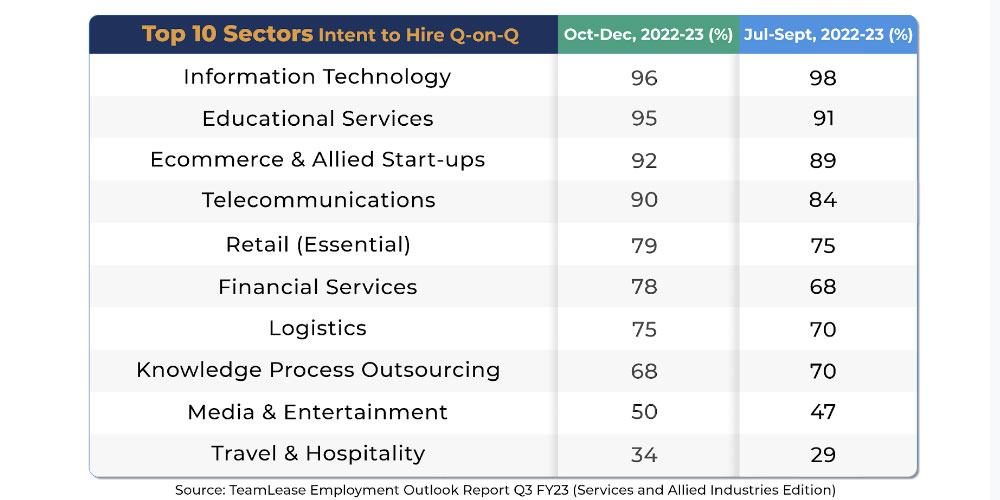
Large firms lead the hiring intent by a significant margin
Employers anticipate strong hiring intent across sectors by business size.
- Small services firms are displaying a healthy appetite for growth and talent demand with a hiring intent of 57%, as demand for services – both India and global – surges in the aftermath of the covid pandemic.
- Medium-sized businesses muster a relatively modest hiring intent (45%), seemingly unable to capitalise as much on current market dynamics as their small counterparts.
- Large firms, on the other hand, lead hiring intent (79%) by a significant margin compared to both small and medium-sized businesses, as seasonality and large contracts from across the globe come to fruition.
Festive quarter brings in good tidings for freshers
While looking into the employment outlook, it can be seen that there is a festive demand in sectors such as E-commerce and Retail at the entry level. The festive quarter will likely bring in glad tidings for freshers and other entry-level talents as hiring intent for this category touches a robust 74% – the highest across all hierarchical levels.
The junior-level category is close on the heels of the entry-level with a hiring intent of 69%. Seasonal demand in sectors such as E-commerce and Retail (Essential) is driving the need for young talent. While mid-level hires enjoy a moderate level of hiring intent (48%), hiring intent at senior levels is at a relatively modest 34%.
Informational Technology and Sales functions continue their top spot in hiring intent
Compared to the previous quarters, this quarter’s employment outlook forecasts a net positive outlook of hiring across functions. Informational Technology at 94% and Sales at 87% continue their leadership in hiring intent at levels significantly better than the other functional areas. The exponentially rising need for digitization and demand for technology professionals is the prime driver behind this uptrend.
Engineering follows not very far behind Sales with a hiring intent at 76%, signalling the demand for specialised and expertise-driven roles, especially in the Information Technology and Telecommunications sectors.
The service sectors that hire for Blue Collar roles – Retail and Logistics – perform at average-to-poor levels compared to other sectors, resulting in a hiring intent at 53%. Office Services and Human Resources lag far behind.
Key takeaways:
Some of the positive indicators to sum up the employment outlook Q3 FY23 report (Services and Allied Industries Edition) include:
- Nearly 73% of employers in the services sector keen to hire this quarter
- IT, Education Services, E-Commerce & Allied Start-ups, and Telecommunications sectors tops the hiring intent
- Metro & Tier-1 cities precede the hiring brigade with the highest intent to hire at 95%
- Bangalore (97%), Chennai (90%) & Delhi (86%) are among the top cities looking to hire
- Entry-level roles sees the highest intent to hire at 74%, followed by junior-level roles at 69%
- IT (94%) and Sales (87%) roles continue to be the highest in demand, followed by the demand for engineering roles
- A remarkable double-digit attrition in the IT, Educational Services, Ecommerce & Allied Start-ups, and Knowledge Process Outsourcing Sectors is expectable
The trends driving transformation in the mechanics of hiring and hiring sentiment are not new but need to be abreast of the dynamics of the current labour market reality. Regardless of uneven economic growth hampered by Covid, the demand for skills in most service sectors and allied industries displayed a fairly impressive intent-to-hire trend. Thus, the prospect of hiring Intent in India’s services sector will likely continue in the third quarter, with 73% of employers keen to upsurge their talent pool.
Do grab the latest copy of TeamLease Employment Outlook Report Q3 FY23 (Services and Allied Industries Edition)
Author

Latest Blogs
Retail Staffing and Recruitment Challenges in India
India's retail sector is undergoing a period of rapid transformation. Driven by rising consumer spending, the expansion of organized retail, omnichannel business models, and growing...
Read MoreCombat Employee Turnover with Predictive AI
Employee attrition has become one of the biggest workforce challenges for modern businesses. It impacts productivity, hiring costs, and long-term growth. Traditional retention strategies often...
Read MoreFuture of Work: Upskilling and Reskilling in the AI Era
The acceleration of artificial intelligence is reshaping labor markets at a pace that conventional education and workforce systems struggle to match. This is not merely...
Read MoreHiring Trends 2026: Workforce Solutions for Recruitment Challenges
India’s labour market in 2026 is undergoing a structural shift. While economic expansion, digital transformation, and AI adoption are accelerating hiring demand, employers continue to...
Read MoreTalent Management Strategy 2026: Skills-First Future-Ready Workforces
Talent management strategy is undergoing a fundamental shift as organizations move beyond traditional hiring models toward building agile, skills-driven workforces. Rapid technological change, AI-led disruption,...
Read MoreD2C business emerging growth opportunity in omnichannel strategy

Consumer brands in India have traditionally marketed to consumers but have sold to customers (distribution partners).D2C enables them to market and sell to consumers.
D2C business entails end to end supply chain management, and hence requires a whole gamut of talent across procurement, factory/warehouse profiles and end-consumer facing salespeople. The sector has grown by more than 100% in 2021 and future hiring is expected to be along the same lines.
D2C brands are seeing a massive upsurge in popularity as they offer a more direct and efficient connection with consumers. These D2C companies set their own prices and control their marketing, working to create a positive customer experience and brand loyalty.
Both the demand and supply sides have contributed to D2C’s emergence and rapid growth. D2C brands are succeeding due to factors such as personalization, creativity, collaboration, and investment, as well as a large, amorphous customer base, mindful shoppers, and rapidly evolving brand loyalty.

D2C comes in 2 flavours:
- Existing manufacturers who diversify their target audience through D2C as part of their omnichannel strategy
- The second being true D2C players, most of whom are digital native.
Logistics aggregators offer end-to-end services, including warehousing and last mile delivery. To provide these services efficiently, they will need to increase their manpower as overall consumerism will go up. Supply chain will also require integration with the upstream and downstream processes.
D2C business models are disrupting the traditional business model and are transforming to a digital experience to engage with more customers.
New trends and opportunities have also led the D2C industry in India. These include an increase in personalized offerings, a greater focus on fulfilling current needs, the adoption of social media and influencer marketing, and the increase in subscription services. In short, the D2C market is expected to thrive in the coming years due to a shift in consumer buying behavior and rise in online presence caused by the pandemic.
The FMCG supply chain is changing quickly, and emphasis is shifting to digital and social media platforms for product distribution. There will be an increase in positions in digital marketing, performance marketing, omnichannel specialists and social media experts, data science, data analytics, user interface and experience design, information security.
The trend has also led to an increase in the number of people employed for automated warehouse, inventory management, website / application design development, data analytics, AI-powered customer support, and the IoT.
A 3PL provider will help D2C brands scale their business in terms of:
- Managing infrastructure and order volumes through adequate manpower and storage space.
- Providing faster delivery
- Low shipping cost
D2C brands have become very popular in recent years. To compete with e-commerce giants and meet customer expectations, D2C brands need to improve their fulfillment capabilities.
By understanding what customers want and need, businesses can develop better products and services that meet those needs. This can be done by collecting data, analyzing it, and using it to improve their offerings. Additionally, businesses can leverage their brand history to create products that resonate with customers.
Today, millennials are increasingly spending money online, and they expect a personalized, convenient experience from brands. This presents an opportunity for brands to provide more value and a better experience to consumers. A D2C approach helps create a consumer centric business while increasing revenue and meeting growth targets.
Author
Latest Blogs
Retail Staffing and Recruitment Challenges in India
India's retail sector is undergoing a period of rapid transformation. Driven by rising consumer spending, the expansion of organized retail, omnichannel business models, and growing...
Read MoreCombat Employee Turnover with Predictive AI
Employee attrition has become one of the biggest workforce challenges for modern businesses. It impacts productivity, hiring costs, and long-term growth. Traditional retention strategies often...
Read MoreFuture of Work: Upskilling and Reskilling in the AI Era
The acceleration of artificial intelligence is reshaping labor markets at a pace that conventional education and workforce systems struggle to match. This is not merely...
Read MoreHiring Trends 2026: Workforce Solutions for Recruitment Challenges
India’s labour market in 2026 is undergoing a structural shift. While economic expansion, digital transformation, and AI adoption are accelerating hiring demand, employers continue to...
Read MoreTalent Management Strategy 2026: Skills-First Future-Ready Workforces
Talent management strategy is undergoing a fundamental shift as organizations move beyond traditional hiring models toward building agile, skills-driven workforces. Rapid technological change, AI-led disruption,...
Read More